

Power Consumption Monitor vs Electricity Consumption Monitor: How to Choose
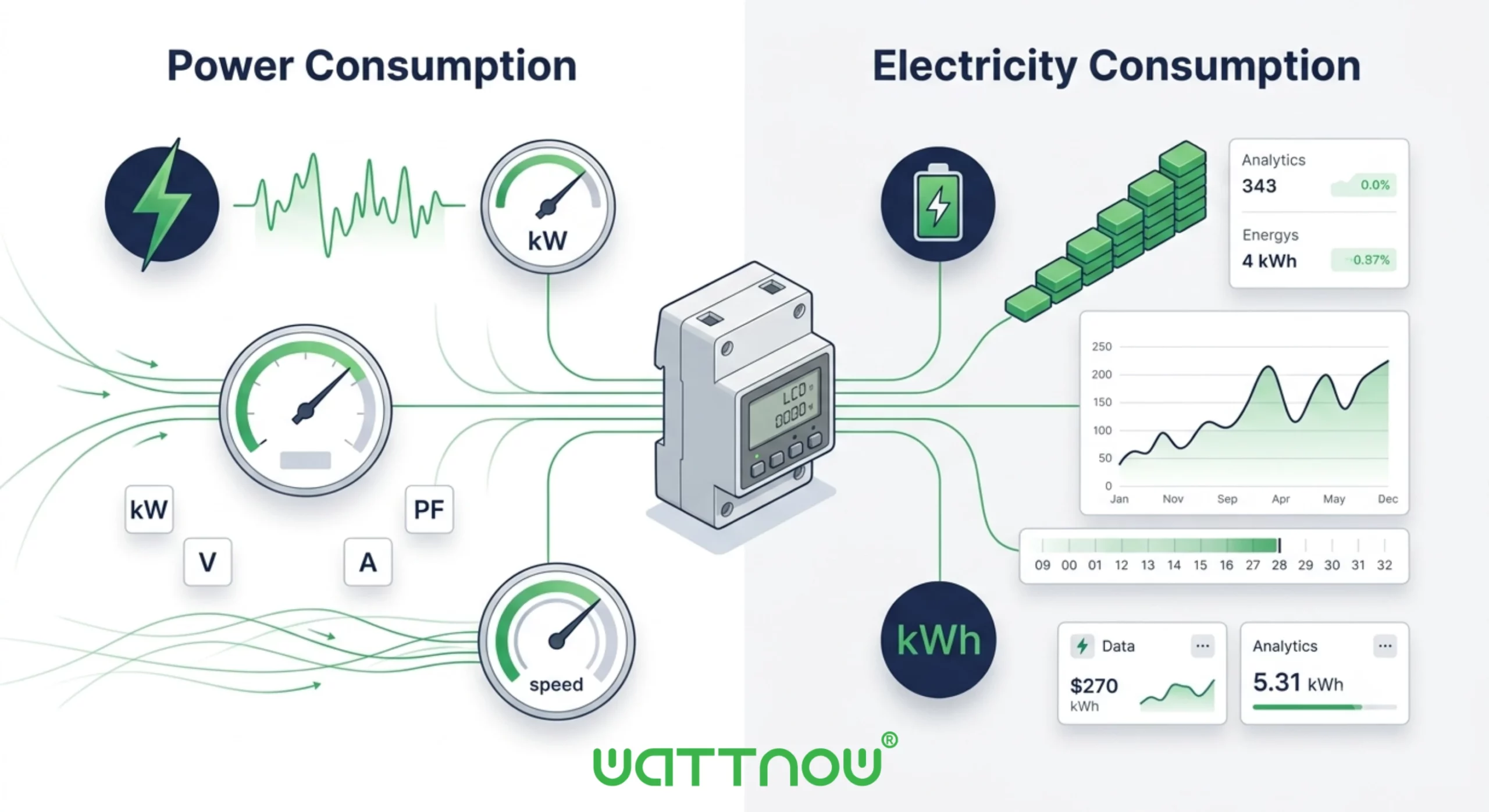
Power usage monitor, electric power usage monitor, electricity consumption monitor: the terminology overlaps, but the right choice depends on what you actually need to measure. Here's how to decide, including for industrial facilities.
Key Takeaways
- A power consumption monitor measures instantaneous load (kW); an electricity consumption monitor measures accumulated energy (kWh).
- Power usage monitor and electric power usage monitor are common synonyms for the same kW-focused device.
- Most facilities need both metrics, not a choice between them.
- Industrial sites should prioritize submetering granularity over picking one "best" device.
- The platform that unifies the data matters more than the brand of sensor used.
Power Consumption Monitor: What It Measures
A power consumption monitor measures the instantaneous electrical load of a circuit or piece of equipment, expressed in kilowatts (kW) or watts (W).
Also called a power usage monitor or electric power usage monitor depending on the vendor, it's the tool you reach for when the question is "how much power is this equipment drawing right now?", which matters for sizing electrical infrastructure and managing peak demand.
Because it captures a snapshot rather than a total, a power consumption monitor is most useful when paired with continuous logging, so you can see not just the current value but how that load moves over a day or a production cycle.
Electricity Consumption Monitor: What It Measures
An electricity consumption monitor tracks accumulated energy used over a period of time, expressed in kilowatt-hours (kWh).
It answers a different question than a power monitor: "how much energy did this line, building, or machine use today, this week, this month?" This is the metric that directly drives your electricity bill, which makes it the more relevant figure for cost reduction and budgeting.
An electricity consumption monitor is generally what you want behind any savings target, since "reduce consumption by X%" is a kWh statement, not a kW one.
Power Consumption Monitor vs Electricity Consumption Monitor
The fastest way to choose: if you're managing peaks, pick a power consumption monitor; if you're managing cost, pick an electricity consumption monitor.
| Criteria | Power Consumption Monitor | Electricity Consumption Monitor |
|---|---|---|
| What it measures | Instantaneous load (kW) | Accumulated energy (kWh) |
| Main question answered | "How much power right now?" | "How much energy used over time?" |
| Best for | Peak demand & equipment sizing | Cost analysis & billing reconciliation |
| Typical user | Electrical & maintenance teams | Energy managers & finance teams |
| Drives demand charges | Directly, since peaks set the charge | Indirectly, via total usage |
| Drives the kWh line on the bill | No | Yes |
| Common synonyms | Power usage monitor, electric power usage monitor | Electricity usage monitor, energy consumption meter |
💡 In practice: most facilities need both. A single platform pulling from both types of measurement gives a complete picture, instead of forcing a choice between one or the other.
Which One Fits Your Goal?
These are illustrative scenarios meant to show how the choice plays out in practice, not specific client results.
Scenario A, sizing new equipment: a facility plans to add a large compressor and needs to confirm the existing electrical panel can handle the additional load without tripping. A power consumption monitor on the relevant circuit shows the actual peak draw under real operating conditions.
Scenario B, reducing a budget line: a finance director wants to cut the electricity line item by a set percentage this year. An electricity consumption monitor, tracked monthly per department, shows where that reduction is actually coming from.
Scenario C, avoiding demand charges: a site's utility contract penalizes consumption peaks. A power consumption monitor with real-time alerts can flag an approaching peak early enough to shed non-critical load before it's billed.
Common Misconceptions
"They measure the same thing"
They don't. kW and kWh answer different questions, and confusing them leads to the wrong device for the wrong goal.
"I only need one or the other"
Most industrial sites benefit from tracking both, since peak management and cost reduction are usually both priorities, just for different teams.
"The most expensive monitor is the most accurate"
Accuracy depends on correct sizing, placement, and calibration far more than price. A mid-range meter correctly installed will outperform a premium one poorly placed.
Which Power Consumption Monitor Is Best for Industrial Facilities?
There's no single best device for an industrial site, the priority should be submetering at the line or machine level, not picking one monitor for the whole building.
A single electric power usage monitor on the main incoming line isn't enough. The priorities shift toward:
- Submetering at the production-line or machine level, not just the building level
- Tracking both instantaneous load and accumulated energy, since both feed different decisions
- Centralizing every reading into one platform, to avoid juggling dashboards per device
- Automated alerts on abnormal peaks, which can trigger demand charges
- Compatibility with the site's existing communication protocol, to avoid a fragmented rollout
How to Choose: A Quick Checklist
Define the question first
Are you trying to manage peak demand, or reduce your total bill? The answer points to a power consumption monitor or an electricity consumption monitor respectively.
Check granularity
Building-level, line-level, or machine-level. The more granular, the more actionable the data.
Confirm compatibility
Make sure the device integrates with your existing electrical panels and communication protocols.
Look at the platform, not just the sensor
The hardware only matters if the data it produces is visible and actionable in real time.
Wattnow: One Platform for Both Metrics
No Need to Choose Between the Two
Wattnow brings together instantaneous load and accumulated energy data from across your facility into a single real-time dashboard, with automated anomaly detection. It's deployed on 800+ industrial and commercial sites across 4 continents, and supports ISO 50001 compliance out of the box.
Related Reading
Frequently Asked Questions
A power usage monitor tracks instantaneous load in kW, while an energy consumption meter tracks accumulated energy used over time in kWh.
There's no single best device. Industrial sites generally need submetering at the line or machine level, combining both instantaneous load and accumulated energy data, unified in one platform rather than one isolated monitor.
It depends on your goal. Choose a power consumption monitor if you need to manage peak demand or size equipment. Choose an electricity consumption monitor if your priority is reducing your overall electricity bill.
Some advanced meters do measure both instantaneous load and accumulated energy. What matters most is whether the platform receiving that data can present both metrics clearly.
Indirectly. It helps avoid demand charges tied to peaks, but the total bill is driven mainly by accumulated energy, which is what an electricity consumption monitor tracks.
No, the terms are used interchangeably across vendors to describe the same type of instantaneous load monitoring device.
Stop Choosing Between Metrics
Wattnow combines power and energy data from your whole facility into one real-time view.
Book a Free Demo