

Cooling Systems: Optimizing Energy Performance
Chilled Water, HVAC, and Refrigeration
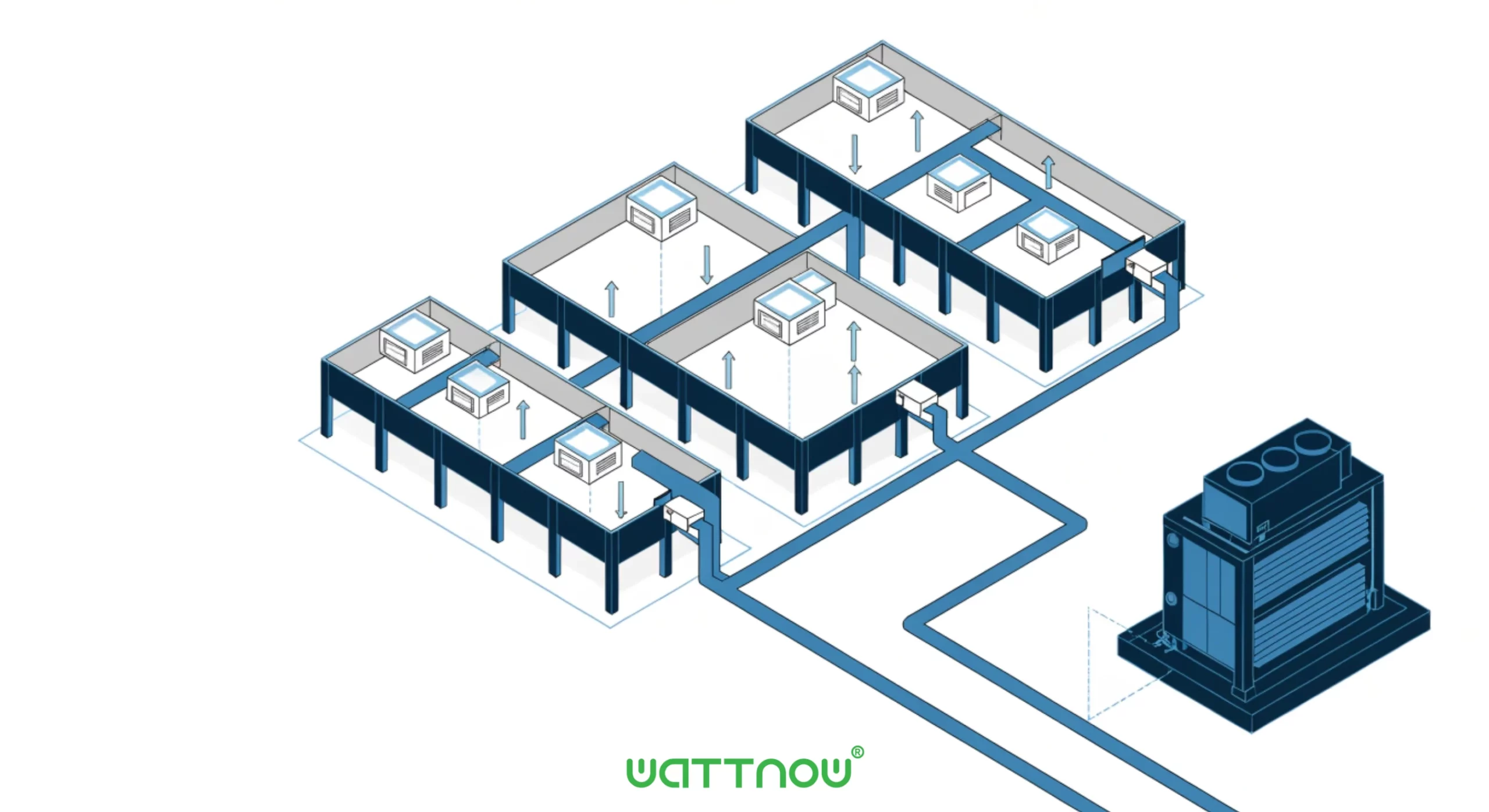
🔎 The challenge: Cooling systems are essential (comfort, processes, cold chain) but energy-intensive. Performance drifts (refrigerant leaks, poor setpoints, fouling) are common and penalize efficiency. Continuous monitoring makes it possible to identify these deviations and effectively control equipment.
Why cooling systems are strategic for your energy performance
In commercial buildings (offices, shopping centers) and industrial facilities (food processing, pharmaceuticals, textiles), cooling systems (chilled water, HVAC, refrigeration) represent the largest share of electricity consumption.
- Commercial buildings: Air conditioning and chilled water production can account for more than half of electricity consumption during summer.
- Food & beverage industry: The cold chain (cold rooms, blast freezers) is essential but highly energy-intensive.
- Pharmaceuticals and laboratories: Cleanrooms and storage areas require strict temperature regulation, with high and continuous energy consumption.
📌 Reference: According to ADEME, a poorly tuned or maintained cooling system can consume significantly more energy than an optimized one. Monitoring and fine-tuning of parameters (setpoint temperatures, pressures, flow rates) are priority levers for action.
Main cooling systems: chilled water, HVAC, refrigeration
Chilled water (chillers)
Production of low-temperature water (4-7 °C) for air conditioning (buildings) or process cooling (industry). A typical system includes a compressor, an evaporator, a condenser, and an expansion valve. Efficiency is measured by EER (Energy Efficiency Ratio) or COP (Coefficient of Performance).
HVAC (Heating, Ventilation, Air Conditioning)
HVAC systems integrate cooling, heating, and ventilation. Chilled water coils and direct expansion (split systems) are the main technologies. Overall performance is assessed by SEER (Seasonal Energy Efficiency Ratio).
Refrigeration (positive and negative cold)
Cold rooms (positive: 0-15 °C), freezers (negative: -20 °C), blast freezers. Refrigerants (R-134a, R-404A, R-410A, R-32, CO₂, ammonia) are regulated by F-Gas legislation.
F-Gas regulation (EU 2024/573): obligations for cooling systems
European regulation (EU) 2024/573, in force since 2024, strengthens obligations for systems containing fluorinated greenhouse gases (F-Gas). It applies to all EU countries and also impacts industries exporting to Europe.
Progressive ban on high-GWP refrigerants
Refrigerants with high GWP (> 2500) have been banned since 2020. The ban is gradually extended to lower-GWP refrigerants (R-404A, R-134a). Low-GWP alternatives (R-32, R-454B, CO₂, ammonia) are encouraged.
Mandatory leak checks
Leak checks are mandatory depending on the refrigerant charge: quarterly for systems > 500 tCO₂ eq, annually for systems > 50 tCO₂ eq. Traceability of interventions is required.
Operator certification
Any intervention on an F-Gas circuit must be carried out by a certified technician. Companies must keep a logbook of refrigerants and interventions.
📌 Impact for businesses: Refrigerant leaks not only lead to regulatory penalties but also reduce energy efficiency (compressor undercharge). Monitoring pressures and temperatures (via Wattnow) allows early detection of anomalies.
Invisible waste in cooling systems
Refrigerant leaks
A refrigerant leak lowers the evaporation pressure, reduces cooling capacity, and increases compressor power consumption. Undercharge is difficult to detect without proper instrumentation.
Poor setpoint temperature adjustment
A setpoint that is too low (e.g., 5 °C instead of 7 °C) increases compressor consumption. Each additional degree of setpoint significantly reduces consumption.
Fouling of heat exchangers (condensers, evaporators)
A fouled condenser reduces heat transfer, increases condensation pressure, and compressor power consumption. Regular maintenance is essential.
Operation outside occupied hours
Many air conditioning systems run at night and on weekends even when spaces are unoccupied. This drift is common in offices, retail spaces, and public buildings.
Optimizing cooling systems: monitoring, tuning, free cooling
IoT Monitoring (Wattnow)
Continuous monitoring of temperatures (chilled water, return, ambient), pressures, flow rates, and electrical consumption (compressors, fans) makes it possible to detect drifts, optimize settings, and trigger alerts in case of anomalies.
Fine-tuning of control parameters
Adjusting setpoints (chilled water temperature, pressure differential, start/stop sequences) allows the system to adapt to the actual load and avoid overconsumption.
Free cooling
When the outdoor temperature is low enough, outside air or a cooling tower can be used to produce chilled water without running the compressor. The feasibility depends on the climate and site configuration.
💡 Objective: IoT monitoring and optimization solutions aim to reduce energy consumption and maintenance costs, with a typical payback period of less than two years.
Wattnow: IoT monitoring for cooling systems
What Wattnow brings concretely
Temperatures (chilled water, return, ambient), pressures (evaporation, condensation), flow rates, and electrical consumption of compressors and fans.
Detection of drifts: abnormal temperature, suspicious pressure deviation (likely leak), compressor overconsumption. Alerts enable rapid intervention.
Automatic calculation of the Energy Efficiency Ratio and Coefficient of Performance. These indicators allow tracking of equipment efficiency over time.
Tracking of refrigerant charges, interventions, and leak checks to facilitate regulatory compliance (refrigerant logbook).
Wattnow identifies waste areas (abnormal consumption, performance gaps) and proposes targeted actions: setpoint adjustment, maintenance planning, sequence tuning.
Frequently asked questions on cooling systems
The reference indicators are EER (Energy Efficiency Ratio) or COP (Coefficient of Performance): the ratio of cooling capacity (kW) to electrical power input (kW). A low EER indicates a drift (refrigerant leak, fouling, poor tuning). Wattnow calculates these indicators continuously from measurement data.
Very low-GWP refrigerants are preferred: R-32 (GWP 675), R-454B (GWP 466), CO₂ (R-744, GWP 1), and ammonia (R-717, GWP 0). R-404A (GWP 3922) has been banned for new installations since 2020. The gradual replacement of existing refrigerants is governed by the F-Gas regulation.
Wattnow monitors evaporation and condensation pressures, as well as subcooling and superheat temperatures. An abnormal drop in evaporation pressure or an increase in superheat indicates undercharge (likely leak). An alert is sent to the maintenance team for investigation.
Free cooling uses outside air (or water from a cooling tower) to produce chilled water without running the compressor. It is beneficial when the outdoor temperature is several degrees below the chilled water setpoint. The benefits depend on the climate and site configuration (presence of cooling towers, heat exchangers).
Official resources and references
Further reading (Wattnow articles)
Ready to take control of your cooling systems?
Wattnow continuously monitors the performance of your cooling equipment, detects drifts (leaks, overconsumption, poor tuning), and helps you reduce your energy bill.
Request a demo