

Energy Consumption Meter: What Is It and How Does It Work?
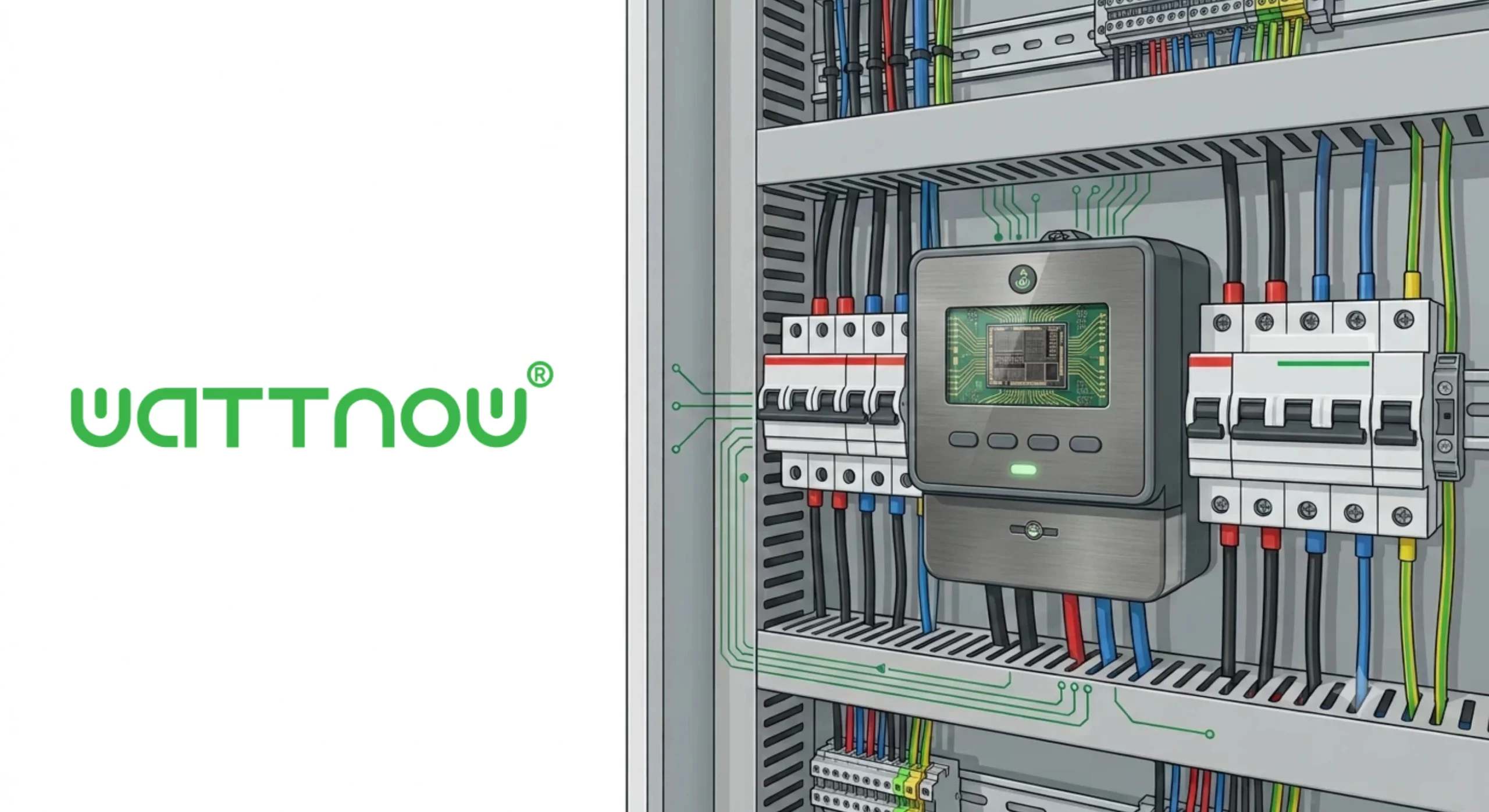
A clear, no-jargon explanation of what an energy consumption meter measures, the main types available, how it differs from a smart meter, and why it's the starting point of any electrical management strategy.
Key Takeaways
- An energy consumption meter measures electrical energy used over time, in kilowatt-hours (kWh).
- "Energy consumption meter" and "electricity consumption meter" are used interchangeably for the same device category.
- Unlike a utility smart meter, it can be installed at sub-circuit or equipment level for a detailed breakdown.
- Main types include panel-mount meters, DIN-rail meters, and wireless submeters.
- Pairing it with a real-time platform is what turns raw readings into actionable savings.
What Is an Energy Consumption Meter?
An energy consumption meter is a device that measures the amount of electrical energy used over a period of time, expressed in kilowatt-hours (kWh), at a chosen point in an electrical installation.
The terms energy consumption meter and electricity consumption meter are generally used interchangeably in the industry. Both describe the same category of measuring device, distinct from voltage meters or current meters which capture only one electrical quantity rather than total energy.
A typical meter records several underlying quantities to arrive at the kWh figure: voltage (V), current (A), active power (kW), and often power factor, a measure of how efficiently that power is actually used. Three-phase industrial installations require a meter capable of reading all three phases, while single-phase meters are sufficient for smaller circuits or individual appliances.
Unlike the single meter installed by your utility provider, which gives one global figure per billing cycle, an energy consumption meter can be installed at different points in a facility: on a main incoming line, a distribution panel, a specific production line, or directly on a single piece of equipment, to break consumption down into usable, comparable detail.
📌 In short: it answers the question "how much electricity did this circuit, machine, or building actually use, and when?", with far more granularity than a utility bill ever provides.
How Does an Energy Consumption Meter Work?
It senses current and voltage at the measurement point, multiplies them to calculate power, then integrates that power over time to produce a cumulative energy figure in kWh.
1. Sensing
A current transformer (CT clamp), often non-invasive and simply clipped around a cable, measures current. Voltage is read directly from the circuit. Some meters require direct wiring instead of a clamp, depending on the amperage involved.
2. Calculation
The meter combines voltage and current readings to compute active power (kW), accounting for power factor, then integrates it over time to produce energy consumed (kWh).
3. Logging
Readings are stored locally or sent to a central platform at regular intervals, from every few seconds to every 15 minutes depending on the meter's communication protocol (commonly Modbus, M-Bus, or wireless).
4. Reporting
The data becomes a usable figure: a daily total, a load curve, a cost estimate, or an alert when consumption deviates from the expected baseline.
Main Types of Energy Consumption Meters
The main types are panel-mount meters, DIN-rail meters, and wireless submeters, each suited to a different installation context.
Panel-Mount Meters
Mounted directly on an electrical panel's front face, giving on-site staff a visible local reading in addition to remote data. Common in industrial switchboards.
DIN-Rail Meters
Compact meters that clip onto the same standardized rail as circuit breakers, inside the panel itself. The most common choice for new electrical installations due to ease of integration.
Wireless Submeters
Battery or mains-powered meters that transmit data wirelessly, useful for retrofitting existing buildings without extensive rewiring.
Multi-Circuit Meters
A single unit reading several circuits simultaneously through multiple CT inputs, reducing hardware cost when monitoring many branch circuits in one panel.
The right choice depends less on brand and more on three factors: how the panel is built, whether the site is new construction or a retrofit, and how many measurement points are needed.
Energy Consumption Meter vs Smart Meter
A smart meter is the single utility-grade meter at a site's main incoming point; an energy consumption meter can be installed anywhere inside the facility for a detailed, sub-circuit breakdown.
Energy Consumption Meter
A broad category. Can be installed anywhere in a facility, at sub-circuit level, to track specific equipment or zones in detail. Owned and chosen by the facility operator.
Smart Meter
Usually refers to the utility-grade meter at the main incoming point, with remote communication back to the energy provider. It gives a single, global view, not a breakdown by equipment or department, and is typically owned by the utility.
💡 In practice: a smart meter tells you what you consumed overall. Submetering with dedicated energy consumption meters tells you where that consumption actually went.
Energy Consumption Meter vs Power Consumption Monitor
An energy consumption meter measures accumulated energy in kWh over time; a power consumption monitor measures instantaneous load in kW at a given moment.
The two are complementary rather than competing. If your goal is to understand your electricity bill or track savings over weeks and months, the kWh figure from an energy consumption meter is what matters. If your goal is to size equipment or manage demand peaks, the kW figure from a power consumption monitor is the relevant one.
We cover this distinction in full, including how to choose between the two for an industrial facility, in our power consumption monitor comparison guide.
Why Real-Time Data Changes the Picture
Real-time data from an energy consumption meter lets you catch waste and anomalies within minutes, instead of discovering them weeks later on a utility bill.
- Spot equipment running outside operating hours, a frequent and easily fixable source of waste
- Detect abnormal consumption before it shows up on the invoice, often a sign of a failing motor or compressor
- Compare consumption between similar machines, lines, or sites to find the outlier
- Build a reliable, granular baseline for ISO 50001 energy reviews and audits
- Quantify the actual impact of an energy-saving initiative, instead of assuming it worked
This is the same logic that underpins a broader Electrical Management System: the energy consumption meter is the sensor, the system is what turns its data into a decision.
Common Misconceptions About Energy Consumption Meters
"My utility smart meter is enough"
It tells you the total, not the breakdown. Without submetering, you can't identify which equipment or department is driving consumption.
"More meters always means more accuracy"
Accuracy depends on correct CT sizing and placement, not meter count. A poorly placed meter on an oversized CT can read less accurately than a single well-configured one.
"The meter alone will save me money"
The meter only produces data. Savings come from someone, or some system, acting on what that data shows. A meter without a monitoring platform is just a number nobody checks.
Where Energy Consumption Meters Are Used
Energy consumption meters are most valuable wherever a facility has multiple pieces of equipment whose individual consumption needs to be isolated and compared.
Production Lines
Isolating consumption per line makes it possible to compare efficiency across shifts, products, or equipment age, and to flag a line drifting away from its normal baseline.
HVAC & Cold Rooms
These systems often run continuously and represent a large, hidden share of a building's electricity bill. Submetering them isolates that share clearly.
Server Rooms & Data Halls
Critical, always-on loads where even small efficiency gains compound significantly over a year of continuous operation.
Warehouses & Logistics Sites
Lighting, refrigeration, and material-handling equipment each have distinct consumption patterns worth tracking separately.
If you're comparing devices for a specific facility, our guide on choosing between a power consumption monitor and an electricity consumption monitor goes into the selection criteria in detail.
Installation Considerations
Installation depends mainly on three factors: whether the site is new construction or a retrofit, the available space inside the electrical panel, and the communication protocol the monitoring platform expects.
- New builds usually allow DIN-rail meters to be specified at the panel design stage, the cleanest and most cost-effective option
- Retrofits often favor wireless submeters or non-invasive CT clamps to avoid extensive rewiring or production downtime
- CTs must be sized to the expected current range; an oversized CT on a lightly loaded circuit reduces reading accuracy
- Confirm the meter's communication protocol (Modbus RTU/TCP, M-Bus, or proprietary wireless) is compatible with your monitoring platform before purchasing
- Installation should always be carried out by a qualified electrician, given the risks involved in working on live panels
How Wattnow Builds On This Data
From Raw Readings to Decisions
Wattnow connects to energy consumption meters across a facility, regardless of brand or protocol, and turns their readings into a single, real-time dashboard. Sites running on Wattnow typically reduce electricity costs by 10 to 30%, while supporting ISO 50001 compliance.
Deployed on 800+ industrial and commercial sites across 4 continents, the platform is built to scale from a single meter to a full multi-site rollout.
Related Reading
Frequently Asked Questions
It's a device that measures the amount of electrical energy used over time, usually in kWh, and can be installed at the main incoming point or on specific circuits and equipment.
Yes, in practice the two terms are used interchangeably to describe the same type of measuring device.
A smart meter is typically the utility-grade meter giving one global reading for the whole site. An energy consumption meter can be deployed at sub-circuit level for a detailed breakdown by equipment or zone.
An energy consumption meter measures accumulated energy in kWh over time. A power consumption monitor measures instantaneous load in kW at a given moment. They answer different questions and are often used together.
It depends on the device, ranging from continuous readings every few seconds to intervals of 15 minutes, which is the standard granularity used for load curve analysis.
Wireless submeters or non-invasive CT clamps are usually the most practical choice for retrofits, since they avoid extensive rewiring and minimize downtime.
No. The meter only produces data. Savings come from acting on that data, typically through a monitoring platform that turns readings into alerts and decisions.
Ready to See Your Real Consumption Data?
Wattnow turns your meters into a single real-time view of your electrical performance.
Book a Free Demo