

Master
Cogeneration &
Trigeneration
Definition, boiler and gas technologies, sizing, STEG Tunisia / EDF OA France / ONEE Morocco contracts, IoT monitoring.
Start
Cogeneration: definition and challenges
Cogeneration definition: produce electricity AND heat with 85% efficiency
Cogeneration (or Combined Heat and Power, CHP) is a thermodynamic system that simultaneously produces mechanical energy (converted to electricity) and useful thermal energy from a single primary fuel. Unlike a conventional thermal power plant that rejects two-thirds of primary energy to the atmosphere, cogeneration captures this "waste" heat for industrial or heating needs.
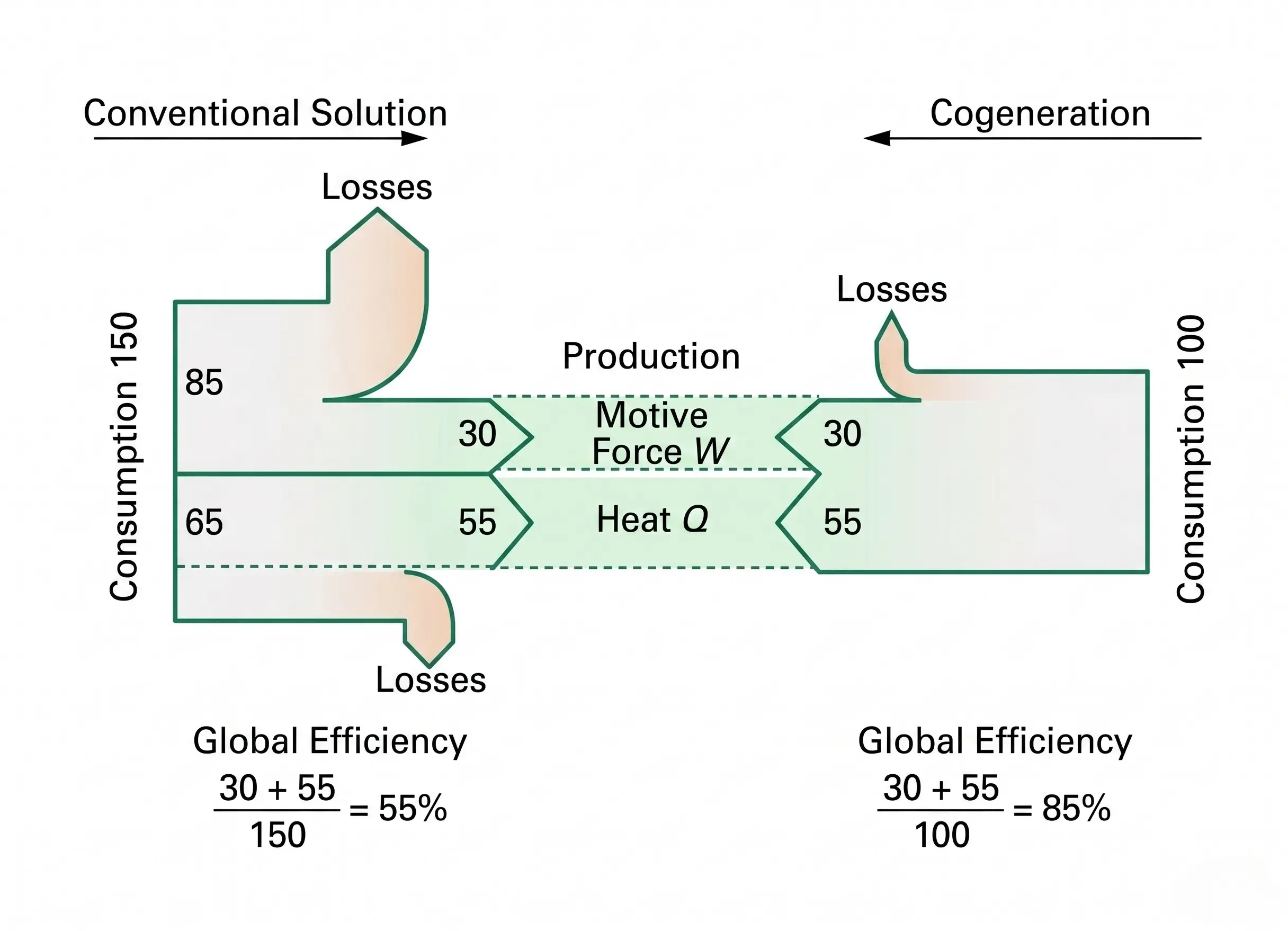
The fundamental principle of cogeneration is based on the second law of thermodynamics: any conversion of heat into mechanical work is accompanied by thermal rejection to a cold source. In a conventional power plant, this cold source is the environment (air or river water) and heat is lost. In cogeneration, this heat is captured and recovered. The electrical efficiency of a conventional EDF plant is about 36% (fossil thermal plants) to 33% (nuclear). A well-sized cogeneration system achieves a global efficiency of 75 to 85%, and up to 90% in trigeneration configuration.
1.1 The three main technology families
Three main families of cogeneration are distinguished:
- Boiler + steam turbine cogeneration (C+TV): historical system, burns all fuels (coal, biomass, waste, heavy fuel oil). High-pressure steam (40-80 bar, 400-500°C) expands through a turbine before feeding processes. Low electrical efficiency (6-18%) as the goal is heat.
- Gas cogeneration by reciprocating engine: most widespread solution for powers from 50 kW to 10 MW. Electrical efficiency 38-42%, global efficiency 80-86%. Ideal for food industry, hospitals, hotels, commercial buildings.
- Gas cogeneration by combustion turbine (GTC): powers from 500 kW to 50 MW, high heat temperatures (200-550°C), suitable for industrial steam needs. Post-combustion possible to increase thermal production.
1.2 Objectives and advantages
A cogeneration installation meets three main objectives:
- Supply security: in case of grid failure, the unit can operate in island mode (autonomy). This is a key criterion for hospitals, data centers, continuous process industries.
- Financial gain: self-produced electricity costs 2 to 4 times less than electricity purchased from the grid. Surplus resale (STEG contract in Tunisia, EDF OA in France, ONEE in Morocco) generates additional revenue.
- Carbon footprint reduction: for each cogenerated MWh of electricity, about 0.5 tonnes of CO₂ emissions are avoided compared to separate production (European average).
In France, by end of 2024, there were over 1,200 cogeneration installations totaling about 2,500 MW of installed electrical capacity. In Tunisia, the potential is estimated at 600 MWe by ANME (National Agency for Energy Conservation), but only 153 MWe were installed by end of 2022, only 25% of the exploitable resource. In Morocco, Law 13-09 opens the way for development, with several ongoing industrial projects in cement, agrifood, and textiles.
Thermodynamic fundamentals & key performance indicators (KPIs)
Three indicators govern any cogeneration decision. Confusing them leads to sizing errors of 20 to 50% and can jeopardize profitability over 20 years.
2.1 Electrical efficiency and global efficiency
For a typical 1 MWe gas engine: ηe ≈ 40%, ηtot ≈ 85%. The minimum regulatory value required in France to benefit from the EDF OA contract is ηtot ≥ 65% (order of November 15, 2016).
2.2 Heat-to-electricity ratio (α)
This is the most important technology selection criterion. If the site's α ratio (thermal needs / electrical needs) is lower than the machine's α, part of the produced heat will be lost to the atmosphere, severely degrading profitability. Typical values: gas engine α = 1.2 to 1.8; simple cycle gas turbine α = 1.5 to 2.5; gas turbine with post-combustion α = 6 to 11; steam turbine α = 4 to 20.
2.3 Primary Energy Savings (PES)
PES is the key regulatory indicator of European Directive 2012/27/EU. The threshold for high-efficiency cogeneration (HEC) is set at PES ≥ 10%. In France, the EDF OA contract requires PES ≥ 10%, calculated each winter season. In Tunisia, decree 2002-3232 amended requires an "energy efficiency certificate" whose calculation is based on an equivalent principle. An installation whose PES falls below 10% loses its HEC qualification and may have its purchase contract suspended (article 18 of the STEG contract).
Wattnow calculates your PES in real time
Our IoT sensors (gas flow meters, electricity meters, temperature sensors on heat networks) calculate PES hour by hour. A continuous monitoring algorithm triggers an SMS/email alert if the 10% threshold is threatened. This monitoring is the only way to guarantee the maintenance of your contract over time; STEG and EDF carry out periodic checks (every 4 years in France).
2.4 Equivalent specific consumption (CE)
This indicator, from the reference document "Cogeneration techniques" (Claude Lévy, Techniques de l'Ingénieur B8910), measures the amount of primary energy actually consumed to produce 1 kWh of electricity, after deducting the savings made on the boiler. For a gas turbine with post-combustion, CE can drop to 0.5-0.8, compared to 1.2-1.5 for a simple recovery gas engine. The lower CE, the more economical the self-produced kWh is in fuel.
Everything your competitor
already knows and you don't
Boiler and gas cogeneration technologies, trigeneration, sizing, STEG/EDF OA/ONEE contracts, profitability.
Industrial professionals
Access confirmed!
Boiler cogeneration & gas cogeneration: in-depth technologies
3.1 Boiler + steam turbine cogeneration (C+TV)
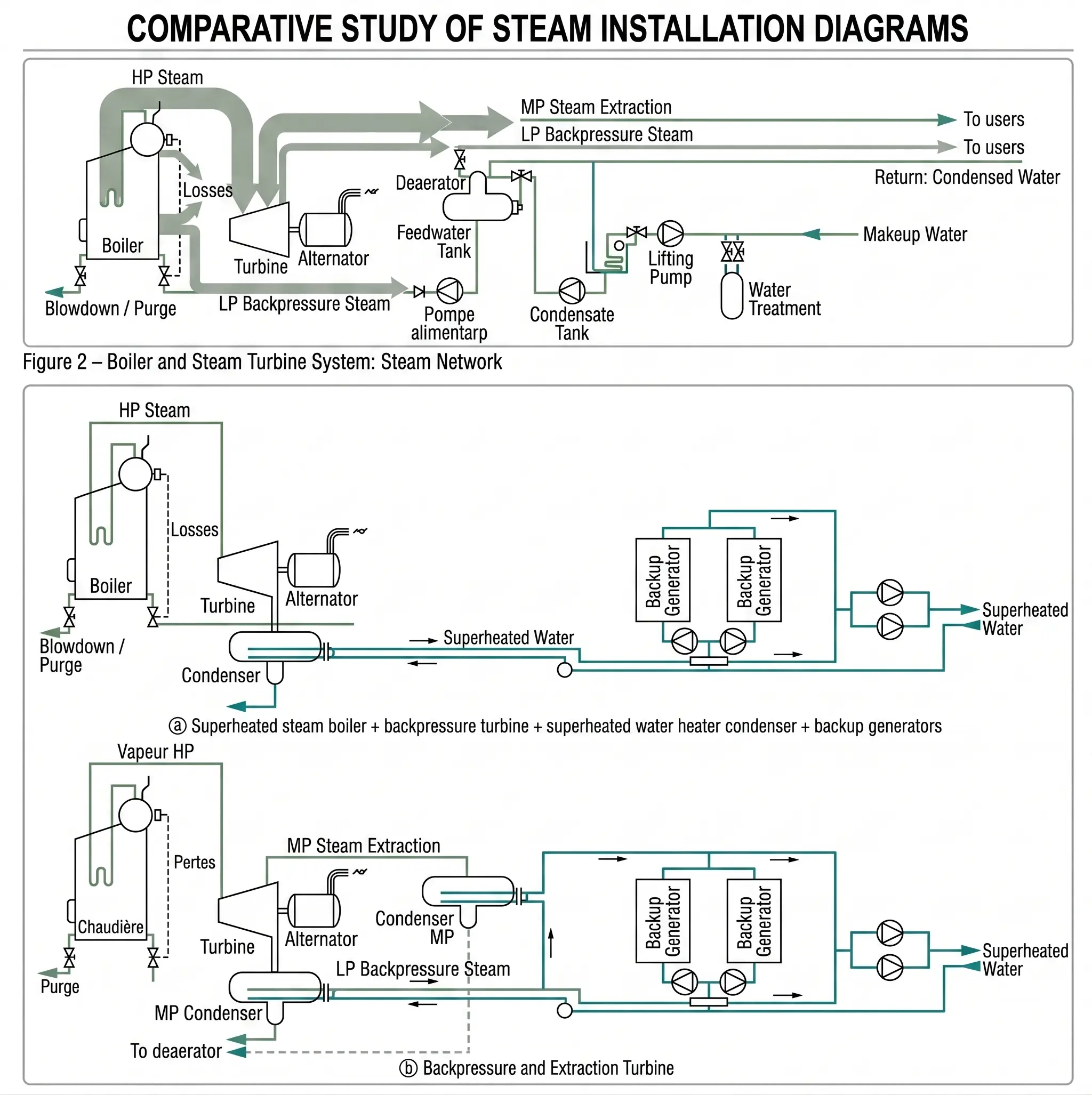
This boiler cogeneration system is the oldest and most robust. It is essential for solid fuels (coal, biomass, municipal waste) and very high powers (>10 MW). The principle: a high-pressure (HP) boiler produces live steam (40 to 80 bar, 400 to 500°C). This steam expands through a steam turbine (ST) driving an alternator. The back-pressure steam (3 to 5 bar, sometimes up to 12 bar) exits the turbine and is sent directly to industrial heat networks or district heating. In waste-to-energy plants (WtE), this is the only possible technology as it uses free heat from waste.
Typical performance (source: Techniques de l'Ingénieur B8910): For steam at 40 bar / 400°C and back-pressure at 4 bar, electrical efficiency is 15% and global efficiency 89%. Electricity production is about 111 kWh per ton of steam. The heat-to-electricity ratio α varies from 4 to 20 depending on steam characteristics. Equivalent specific consumption CE ranges between 1.1 and 1.3. Investment is high: €6,000 to €12,000 per electrical kW.
3.2 Gas cogeneration by reciprocating engine
Gas cogeneration by reciprocating engine is the preferred solution for powers from 50 kW to 10 MW. The gas engine (natural gas, biogas, biomethane, up to 30% hydrogen) drives a synchronous alternator. Heat is recovered at two levels:
- Exhaust fumes (30% of fuel energy): temperature 450-550°C. A tubular heat exchanger or recovery boiler lowers fumes to 100-120°C.
- Engine block cooling (HT circuit) (20% of energy): water at 85-95°C. Some specially designed cogeneration engines allow output at 105°C.
- Oil and turbocharger air cooling (LT circuit) (15% of energy): water at 40-50°C, usable for preheating or domestic hot water.
Full-load electrical efficiency reaches 38-42% for spark-ignited gas engines and 42-48% for Diesel Dual-Fuel engines (gas + pilot diesel). Global efficiency (electricity + useful heat) is 80-86%. The heat-to-electricity ratio α varies from 1.2 to 1.8.
Speed selection: Medium-speed engines (750-1000 rpm) offer the best compromise between compactness and durability (complete overhaul every 15,000-30,000 hours). High-speed engines (1500 rpm) are 30% cheaper to purchase but require overhauls every 6,000 hours; their maintenance cost per kWh is twice as high. Low-speed engines (400-600 rpm) are very robust (overhaul 60,000 hours) but more expensive and bulkier; they are justified for powers > 4 MW.
3.3 Gas cogeneration by combustion turbine (GTC)
Combustion turbines (GTC) derive from aeronautical technology. The compressor draws in air (350-500% excess air), discharges it at 6-20 bar into the combustion chamber where natural gas (or fuel) is burned. Fumes at 650-1000°C expand through the turbine: the first stages drive the compressor, the last stages drive the alternator. Exhaust gases exit at 450-550°C, clean with 15-17% residual oxygen.
Advantages: compactness, light weight, low maintenance (overhaul every 30,000-60,000 h), high heat temperature (ideal for industrial steam). Disadvantages: lower electrical efficiency than engines (25-35% at full load), efficiency collapse at partial load (loss of 15-25% at 50% load), high gas supply pressure (13-20 bar, sometimes requiring an expensive booster).
Post-combustion: Thanks to residual oxygen in exhaust gases, an additional burner (air-vein or turbulent burner) can be added between the turbine and the recovery boiler. Additional fuel is injected and burns in the hot gases. Global efficiency then reaches 88-91%, and the α ratio becomes very high (6 to 11). Equivalent specific consumption CE drops to 0.5-1.1, the best of all technologies. This configuration is particularly interesting when thermal demand greatly exceeds electrical demand (district heating plants, chemical industries).
• 1 MW gas engine: ηe 40%, α 1.5, CE 1.2-1.5, investment €4,000-7,000/kW
• 1 MW gas turbine (simple recovery): ηe 28%, α 2.0, CE 1.6-2.0, investment €4,000-6,000/kW
• 1 MW gas turbine + post-combustion: ηe 28%, α 8, CE 0.7-1.0, investment €5,000-7,000/kW
• 5 MW boiler + steam turbine: ηe 15%, α 5, CE 1.1-1.3, investment €6,000-12,000/kW
Trigeneration: adding cooling to the equation
Trigeneration (or Combined Cooling, Heating and Power – CCHP) consists of adding an absorption chiller to a cogeneration heat network. During summer, when heating needs decrease, the "waste" heat that would be lost is converted into cooling for air conditioning or industrial processes. Global efficiency then exceeds 90% and the installation runs 8,000 h/year instead of 4,500 h for simple cogeneration.
4.1 Absorption chiller: principle and COP
Unlike a compression chiller (driven by an electric motor), an absorption chiller uses a heat source as its driving energy. The most common cycle is the lithium bromide (LiBr) / water pair for heat temperatures of 80-120°C (ideal for gas cogeneration). The COP of a single-effect absorption chiller is 0.6-0.7; double-effect reaches 1.0-1.3. This COP seems low compared to 3-6 for a compression chiller, but the energy source (waste heat) is free in cogeneration: each non-recovered thermal kWh is a pure loss. In trigeneration, this kWh is recovered to produce 0.7 kWh of cooling, which would have required 0.2 kWh of electricity in compression.
4.2 Target sectors for trigeneration
- Agrifood: dairies, slaughterhouses, canneries – simultaneous need for cooling (storage, refrigeration) and heat (pasteurization, sterilization, CIP cleaning). Trigeneration makes it possible to recover heat both summer and winter, with a very high annual load factor.
- Hotels & shopping centers: need for air conditioning in summer and heating in winter. Trigeneration operates in cogeneration mode in winter (heating) and in "trigen" mode in summer (air conditioning). Some installations reach 7,500 operating hours per year.
- Data centers: servers need cooling all year round. Recovered heat can be used to heat adjacent offices or be injected into a district heating network. This is a very promising emerging application.
- Chemical and pharmaceutical: some processes require both heat (reactors) and cooling (crystallization, condensation). Custom trigeneration can replace two separate systems.
Intelligent control of three vectors
Trigeneration is more complex than simple cogeneration: real-time arbitration is needed between sending heat to the industrial process, to absorption (cooling), or storing it. Wattnow deploys an economic dispatch algorithm that, at each instant, calculates the marginal value of each vector (process heat, cooling, electricity) and directs flows to maximize PES and financial gain. This predictive control, based on weather forecasts and hourly rates (STEG, EDF OA), increases profitability by 8 to 15% compared to simple automatic mode operation.
4.3 Trigeneration sizing
The power of the absorption chiller is determined by the summer cooling demand curve and the residual heat demand curve after process. The general rule: size absorption to cover 60-80% of the cooling peak, with the remainder provided by existing compression chillers (lower investment). It is essential to keep a compression chiller for safety and peaks. The return on investment for trigeneration is generally 1 to 2 years longer than for simple cogeneration, but the 15-year NPV is higher due to additional operating hours.
Sizing & optimal power selection
The golden rule, derived from European Directive 2012/27/EU and confirmed by thousands of installations: size based on the thermal or electrical base load, never on the peak. A cogeneration system must operate at least 5,000 hours per year at a load > 60% to be profitable.
5.1 Monotonic load curve method
The monotonic load curve classifies all hours of the year by decreasing power (from highest to lowest). The thermal demand curve and electrical demand curve are plotted. The optimal cogeneration power is that corresponding to 5,000-7,000 operating hours per year, i.e., the flattest part of the curve (base load). Beyond this point, the remaining hours (2,000-3,000 h/year) correspond to short peaks, which are more economically covered by the grid and conventional boilers.
Concrete example: A factory has a thermal need of 1,500 kW for 1,000 h/year (winter peaks), 1,000 kW for 4,000 h/year (mid-season), and 500 kW for 3,000 h/year (summer). The optimal power is about 1,000 kW (which will operate 7,000 h/year). Sizing at 1,500 kW would make the cogeneration operate at partial load (66% load) for 4,000 h/year, with electrical efficiency degraded by 5 to 10 points.
Mistake #2: neglecting changes in needs. A dairy sized its cogeneration on year N needs, but its activity dropped by 20% in 2 years. Today, PES is 8% and the STEG contract is threatened. Solution: plan a bypass on heat recovery from the start to be able to reject excess without penalizing PES.
Mistake #3: choosing a technology without checking gas pressure. A gas turbine requires 13-20 bar. In Tunisia, the STEG distribution network often delivers 4-8 bar. Adding a booster consumed 3% of electricity production and increased investment by 15%, killing profitability.
STEG (Tunisia), EDF OA (France), ONEE (Morocco) contracts
- Decree 2002-3232 2022-12
- Duration: 20 years (art.21) automatic annual renewal
- Mandatory energy efficiency certificate – calculated on global efficiency basis
- 4 time-of-use periods: Summer Morning Peak (8:30am-1:30pm) best paid, Evening Peak, Day, Night
- Exclusive sale to STEG – no third-party transfer allowed
- Remote-readable metering mandatory (art.7)
- Possible termination after 60 days of formal notice (art.18)
- C13 (≤300kW) C16OA (300kW-1MW)
- Duration: 12 years (cogeneration), renewable
- Mandatory PES ≥ 10% (Directive 2012/27/EU)
- Higher winter tariff (November-April) + PES bonus indexed to avoided gas price
- Periodic control every 4 years (order of November 2, 2017)
- Gas excise tax (TICGN): €16.39/MWh as of February 1, 2026
- Law 13-09 on Renewables
- Self-consumption authorized for installations ≤ 10 MW
- Surplus sale to ONEE possible via tender for projects > 1 MW
- Framework under development – implementing decrees in progress (2025-2026)
- Pilot projects in industry (cement, agrifood, textiles)
6.1 STEG Contract – Article-by-article breakdown (decree 2022-12)
6.2 The EDF OA scheme in France
The French Purchase Obligation (OA) mechanism is governed by the law of February 10, 2000 and tariff orders. For gas cogeneration installations, two main contracts exist:
- C13 Contract (order of December 28, 2015): for installations with power ≤ 300 kW. Fixed tariff + energy efficiency bonus. Duration 12 years.
- C16OA Contract (order of November 15, 2016): for installations from 300 kW to 1 MW. Tariff composed of a fixed part and a variable part indexed to the avoided gas price. The PES bonus is calculated each winter season based on actual measured PES. Duration 12 years.
- C16CR Top-up Remuneration: for installations > 1 MW, by tender. Duration 15 years.
The winter season (November to April) benefits from a tariff about 20-30% higher than the summer season, because EDF needs power in winter. This is a strong incentive to run cogeneration primarily in winter. The excise tax on natural gas (TICGN) is set at €16.39/MWh since February 1, 2026 (order of January 27, 2026).
Profitability, investments and financial support mechanisms
| Electrical power | Investment (€) | Annual savings (€) | Payback (years) | 15-year NPV (€) |
|---|---|---|---|---|
| 500 kW | 600,000 | 180,000 | 3.3 | 2,100,000 |
| 1 MW | 1,000,000 | 320,000 | 3.1 | 3,800,000 |
| 2 MW | 1,700,000 | 600,000 | 2.8 | 7,200,000 |
| 5 MW | 3,500,000 | 1,400,000 | 2.5 | 17,000,000 |
Assumptions: gas price €0.06/kWh, electricity price €0.15/kWh, 7,000 h/year, maintenance €0.012/electrical kWh, discount rate 8%.
Country subsidies
- 🇫🇷 France: Energy Savings Certificates (CEE): 8 to 15 GWhcumac for 1 MW = €80,000 to €150,000 one-time. Winter PES bonus included in EDF OA tariff. ADEME study aid (up to 50% of amount). Accelerated depreciation over 5 years (finance law).
- 🇹🇳 Tunisia: National Energy Conservation Fund (FNME) / Energy Transition Fund (FTE): subsidy up to 20% of investment cost. Concessional credit lines from AFD (French Development Agency) and World Bank. Customs duty exemption on imported equipment (decree 2022-12).
- 🇲🇦 Morocco: Tenders dedicated to cogeneration under the Moroccan Solar Plan. Energy Development Fund (FDE) for feasibility studies. EIB (European Investment Bank) credit line for industrial projects.
Case study: industrial dairy in Tunisia
Context: Industrial dairy with 230 employees, operating 3 shifts. Needs: electrical 850 kW base (5,800 h/year), thermal 1,150 kW (pasteurization, CIP cleaning, space heating), cooling 600 kW for cold rooms (+4°C and -18°C). Initial energy bill: €2.1 million/year (electricity + boiler gas).
| Measured indicator | Value | Verdict |
|---|---|---|
| Base electrical power (hours > 5,000h) | 850 kW — 5,800 h/year | ✅ Eligible for cogeneration |
| Base thermal demand | 1,150 kW — 6,000 h/year | ✅ Site α ratio = 1.35 (gas engine suitable) |
| Continuous cooling demand | 600 kW cooling | ✅ Trigeneration candidate |
📊 Results after 18 months
Energy bill: reduced from €2,100,000 to €1,780,000 (-15.2%). Direct savings: €320,000/year. French CEE received (French head office): €120,000. Total investment: €1,150,000 (engine €750k, absorption €180k, civil works €120k, IoT €25k, studies €75k). Payback = 2.8 years. Average PES maintained at 31% over 18 months. Energy efficiency certificate renewed without difficulty. The system avoided 890 tonnes of CO₂ per year. The company obtained the "Eco-Energy Enterprise" label from ANME.
IoT & advanced energy monitoring
An unmonitored cogeneration system loses 10 to 20% of its theoretical profitability — and risks losing its purchase contract due to non-compliance with PES or the energy efficiency certificate. Continuous IoT monitoring is the only way to guarantee performance over 20 years.
| KPI | Formula | Alert threshold | Corrective action |
|---|---|---|---|
| PES (Primary Energy Savings) | Directive 2012/27/EU formula | < 12% pre-alert < 10% critical alert | Check heat exchangers, combustion settings, absorption bypass |
| Electrical efficiency ηe | Welec / Qgas LHV | < 35% (new gas engine 40%) | Schedule maintenance (spark plugs, injectors, turbo) |
| Heat utilization rate | Quseful process+absorption / Qrecovered | < 70% | Review dispatch strategy, check bypass |
| Absorption COP | Qcooling / Qheat consumed | < 0.55 (new 0.65) | Check LiBr concentration, purge non-condensables |
| Operating hours | Cumulative counter | < 5,000 h/year | Revise sizing or add heat storage |
9.1 Wattnow Architecture
① Field sensors: Three-phase electricity meters (class 0.5S), ultrasonic flow meters on heat/cooling networks, PT100 class A temperature sensors, optional gas analyzer (O₂, CO). ② Edge gateway: Acquisition every 10 seconds, calculation of elementary indicators (powers, flows), 72h local buffer, TLS 1.3 encrypted transmission to cloud. ③ Wattnow Cloud: Continuous PES calculation (1-hour step), CUSUM drift detection (Cumulative Sum Control Chart), SMS/email/API alerts, automated ISO 50001 reporting (monthly, annual reports, energy efficiency certificate). 10-year archiving for audits. ④ Dashboard: Web and mobile, real-time view, history, multi-site comparison, "Optimized Dispatch" module that recommends in real time the allocation of heat (direct process vs absorption vs storage).
Early detection by CUSUM – real case
At a chemical site equipped with a 2 MW gas cogeneration system, the CUSUM algorithm detected a progressive drift in electrical efficiency of +6% over 4 weeks (i.e., a drop from 40% to 34%). The cause: partial fouling of the exhaust gas recovery heat exchangers, increasing back-pressure and reducing mechanical power. Preventive cleaning was scheduled immediately, avoiding a major breakdown (estimated cost €45,000 in production loss + €25,000 in repairs). PES remained above the contractual threshold (12% vs 10% threshold).
Appendices & complete regulations
10.1 Reference efficiencies by technology
| Technology | ηe | ηth | ηtot | Typical PES |
|---|---|---|---|---|
| Gas engine full load (1 MW) | 38-42% | 42-48% | 80-86% | 28-35% |
| Gas engine 50% load | 30-34% | 35-40% | 65-74% | 12-20% |
| Simple cycle gas turbine (1 MW) | 25-30% | 45-50% | 70-80% | 18-25% |
| Gas turbine + post-combustion | 24-28% | 60-65% | 84-90% | 30-42% |
| C+TV (40 bar steam, 4 bar back-pressure) | 14-16% | 72-76% | 86-90% | 20-28% |
| Fuel cell (PEMFC) – H2 | 45-55% | 25-35% | 75-85% | 25-35% |
10.2 Pre-project checklist (before feasibility study)
- ✅ Base electrical demand ≥ 50 kW constant over ≥ 5,000 h/year (check 12-month load curve)
- ✅ Synchronous thermal demand (heat usable when engine runs) – at least 70% of recovered heat must be utilized
- ✅ Site α ratio (Q/W) compatible with chosen technology (gas engine: 1.2-1.8; turbine: 1.5-2.5)
- ✅ Sufficient natural gas supply: pressure (≥4 bar for engine, ≥13 bar for turbine), flow, quality (biomethane accepted)
- ✅ Available space for cogeneration room: 15-60 m² depending on power, ventilation, maintenance access
- ✅ LV or MV electrical connection feasible (distance to substation, short-circuit power)
- ✅ Regulatory study: ICPE (France) / STEG authorization + efficiency certificate (Tunisia) / ONEE authorization (Morocco)
- ✅ NPV/IRR analysis with and without subsidies (French CEE / Tunisian FNME / Moroccan FDE) – minimum IRR > 12%
- ✅ IoT monitoring strategy for PES maintenance and certificate renewal – budget to plan (1-3% of investment)
10.3 Glossary
- CHP: Combined Heat and Power (cogeneration).
- CCHP: Combined Cooling, Heating and Power (trigeneration).
- PES: Primary Energy Savings – key indicator for HEC qualification.
- LHV: Lower Heating Value – basis for efficiency calculation.
- C+TV: Boiler + Steam Turbine.
- RE: Reciprocating Engine (gas cogeneration).
- GTC: Gas Turbine (combustion turbine).
- HRSG: Heat Recovery Steam Generator.
- WtE: Waste-to-Energy plant (municipal waste incineration).
- COP: Coefficient Of Performance (cooling efficiency).
Personalized assessment for your project
Our experts analyze your consumption profile, size the optimal solution (gas engine, turbine, trigeneration), guide you through STEG, EDF OA or ONEE procedures, and deploy ISO 50001-compliant IoT monitoring.
Book a free assessmentMaîtrisez la
Cogénération &
Trigénération
Définition, technologies chaudière & gaz, dimensionnement, contrats STEG Tunisie / EDF OA France / ONEE Maroc, pilotage IoT.
Lire
Cogénération : définition et enjeux
Cogénération def : produire électricité et chaleur avec 85% de rendement
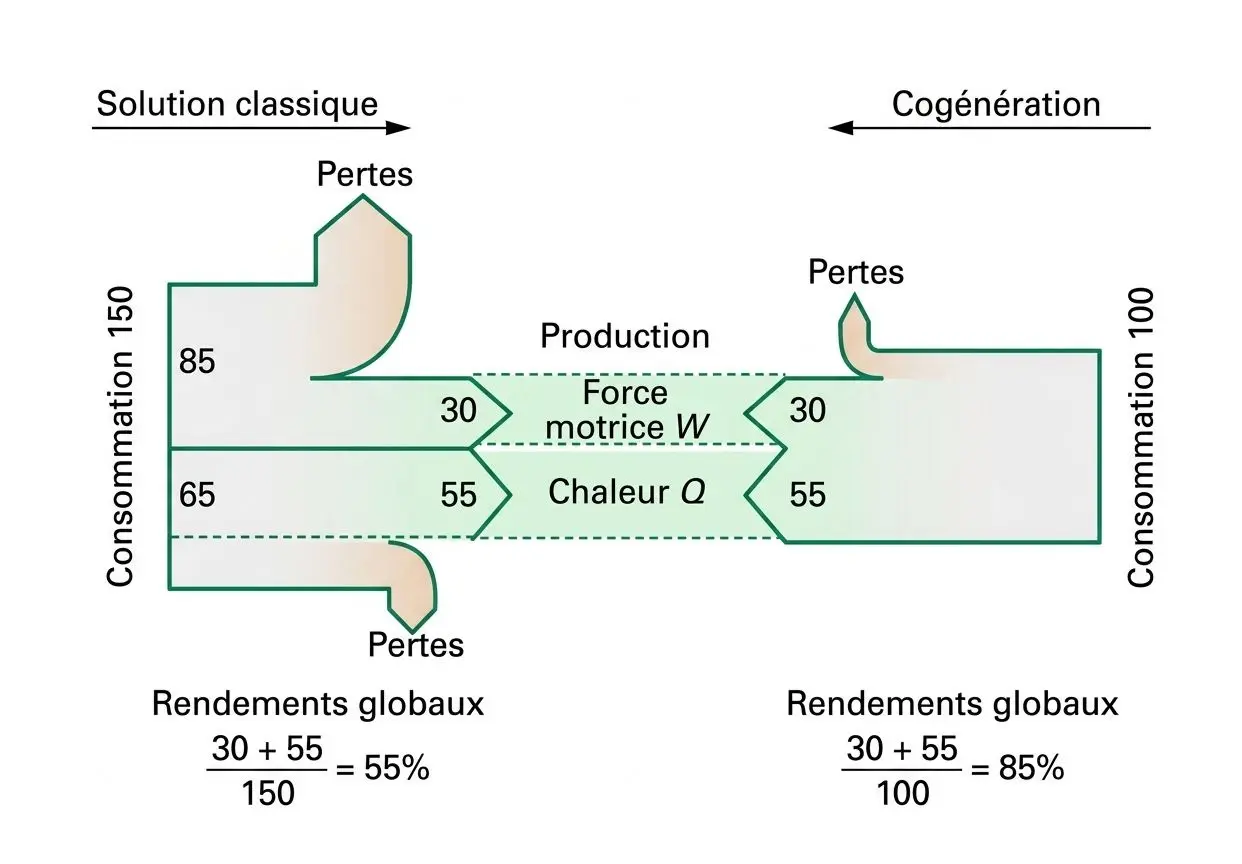
La cogénération (CHP) produit simultanément électricité et chaleur utile à partir d’un seul combustible. Rendement global jusqu’à 85% contre ~55% pour une centrale classique.
Trois filières principales : cogénération chaudière + turbine vapeur (combustibles solides), cogénération gaz par moteur alternatif (50kW-10MW, ηélec 38-42%) et turbine à combustion (500kW-50MW). La cogénération réduit les émissions CO₂ de 30-50% et offre une sécurité d’approvisionnement.
Fondamentaux thermodynamiques & indicateurs clés (KPIs)
Le rapport chaleur/électricité α (Qch/Wél) guide le choix technologique. Moteur gaz α ≈ 1,2-1,8 ; turbine gaz α ≈ 1,5-2,5. L’EEP est l’indicateur réglementaire critique : en dessous de 10%, le contrat d’achat peut être suspendu.
Wattnow calcule votre EEP en temps réel
Capteurs IoT + algorithme de surveillance continue → alertes si seuil EEP menacé. Garantie de maintien des contrats STEG / EDF OA.
Tout ce que votre concurrent
sait déjà
Technologies détaillées, contrats officiels, rentabilité, cas concret.
Professionnels de l’industrie
Accès confirmé !
Cogénération chaudière & cogénération gaz
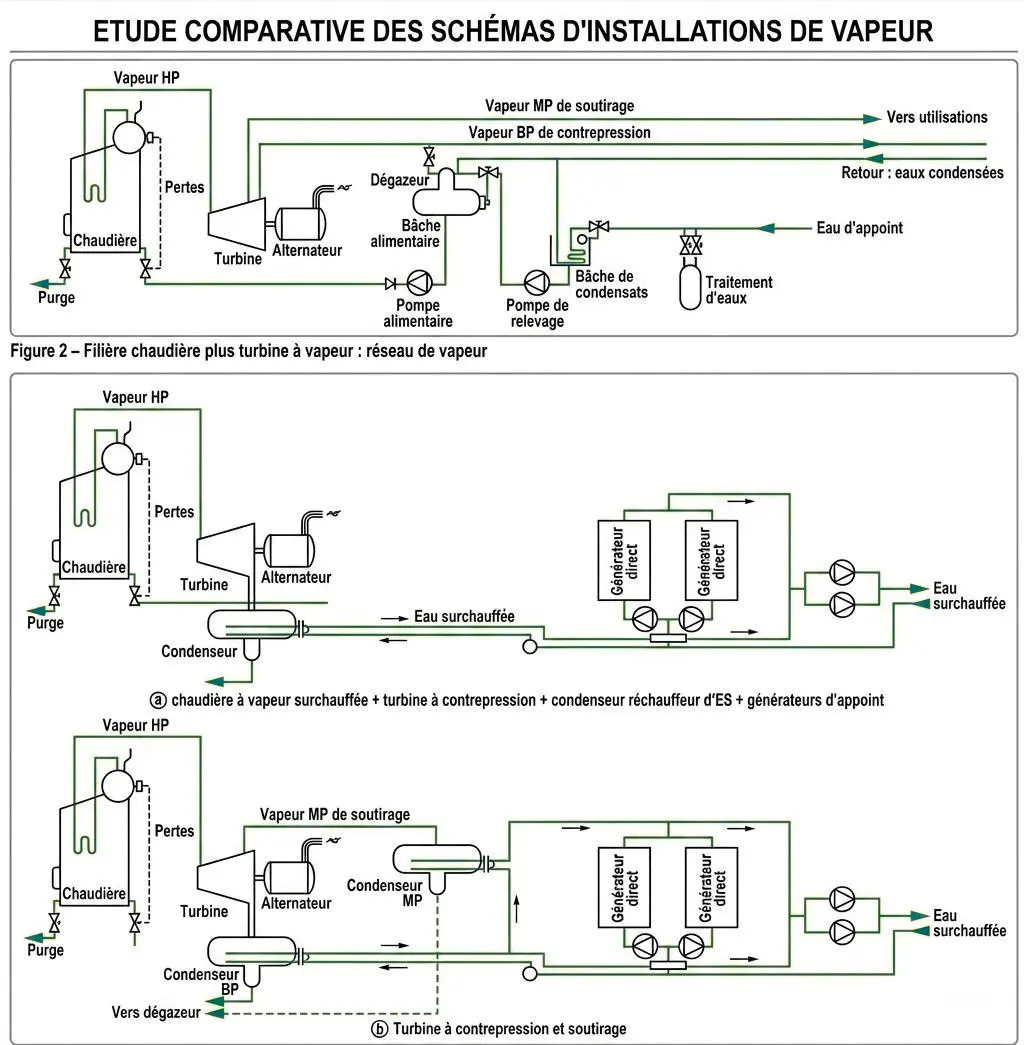
Cogénération chaudière + turbine vapeur : puissante (>10 MW), combustible solide, rendement électrique 14-16%, α=4-20. Cogénération gaz moteur : 50kW-10MW, ηélec 38-42%, ηglobal 80-86%, α=1,2-1,8. Turbine à combustion : chaleur haute température, post-combustion possible (α=6-11). Choix selon profil de charge.
Trigénération : ajouter le froid
Machine à absorption LiBr/eau (COP 0,6-1,3) valorise la chaleur fatale estivale pour climatisation ou froid process. Idéal pour agroalimentaire, hôtellerie, data centers. La trigénération permet 7 500 h/an de fonctionnement et rendement global >90%.
Pilotage dynamique Wattnow
Algorithmes de dispatch entre chaleur process, absorption et stockage → +8 à 15% de rentabilité.
Dimensionnement & puissance optimale
Règle d’or : dimensionner sur la charge de base (≥5 000 h/an). La puissance optimale correspond à la zone plateau de la courbe de charge. Exemple : besoin thermique 1 500 kW (pointe) / 1 000 kW (base) → puissance 1 000 kW. Éviter dimensionnement sur pointe électrique sous peine d’EEP <10%.
Contrats STEG, EDF OA, ONEE
- Décret 2022-12, durée 20 ans
- Attestation d’efficacité énergétique obligatoire
- 4 postes horaires, vente exclusive
- Contrats C13 (≤300kW) / C16OA (300kW-1MW)
- Durée 12 ans, EEP ≥10% obligatoire
- Tarif hiver majoré + prime EEP
- Loi 13-09, autoconsommation ≤10 MW
- Vente surplus via appels d’offres
- Cadre en développement
Le contrat STEG impose comptage télérelevable et résiliation possible si attestation d’efficacité retirée. En France, contrôle périodique tous les 4 ans.
Rentabilité, investissements et aides
| Puissance | Investissement | Économie/an | TRS (ans) |
|---|---|---|---|
| 500 kW | 600 k€ | 180 k€ | 3,3 |
| 1 MW | 1 000 k€ | 320 k€ | 3,1 |
| 2 MW | 1 700 k€ | 600 k€ | 2,8 |
Aides : France : CEE (80-150k€) ; Tunisie : subvention FNME jusqu’à 20% ; Maroc : FDE études. VAN sur 15 ans typique >3,8 M€ pour 1 MW.
Cas concret : Laiterie Tunisie
📊 Résultats après 18 mois
Cogénération gaz 900 kW + absorption 500 kW froid. Facture énergie : 2,1 M€ → 1,78 M€ (économie 320 k€/an). Investissement 1 150 k€, TRS = 2,8 ans. EEP maintenu à 31%, contrat STEG validé, 890 t CO₂ évitées.
IoT & pilotage énergétique avancé
| KPI | Seuil alerte | Action |
|---|---|---|
| EEP | <12% | Vérifier échangeurs, combustion |
| η électrique moteur | <35% | Planifier entretien bougies/turbo |
| Taux utilisation chaleur | <70% | Revoir dispatch |
Architecture Wattnow : capteurs terrain → edge computing → cloud avec CUSUM → alertes proactives. Détection de dérive évitant rupture de contrat.
Annexes & réglementation
Textes clés : Directive UE 2012/27/UE, décret Tunisien 2022-12, arrêté français 15/11/2016, loi marocaine 13-09. Checklist pré-projet : besoin base ≥5 000 h/an, compatibilité α site/technologie, pression gaz, monitoring IoT inclus.
Diagnostic personnalisé pour votre projet
Analyse de faisabilité, dimensionnement optimal, accompagnement STEG/EDF/ONEE, IoT certifié ISO 50001.
Réserver un diagnostic gratuit →