

Power Outages in Tunisia: causes, STEG's actions and solutions for a more resilient grid
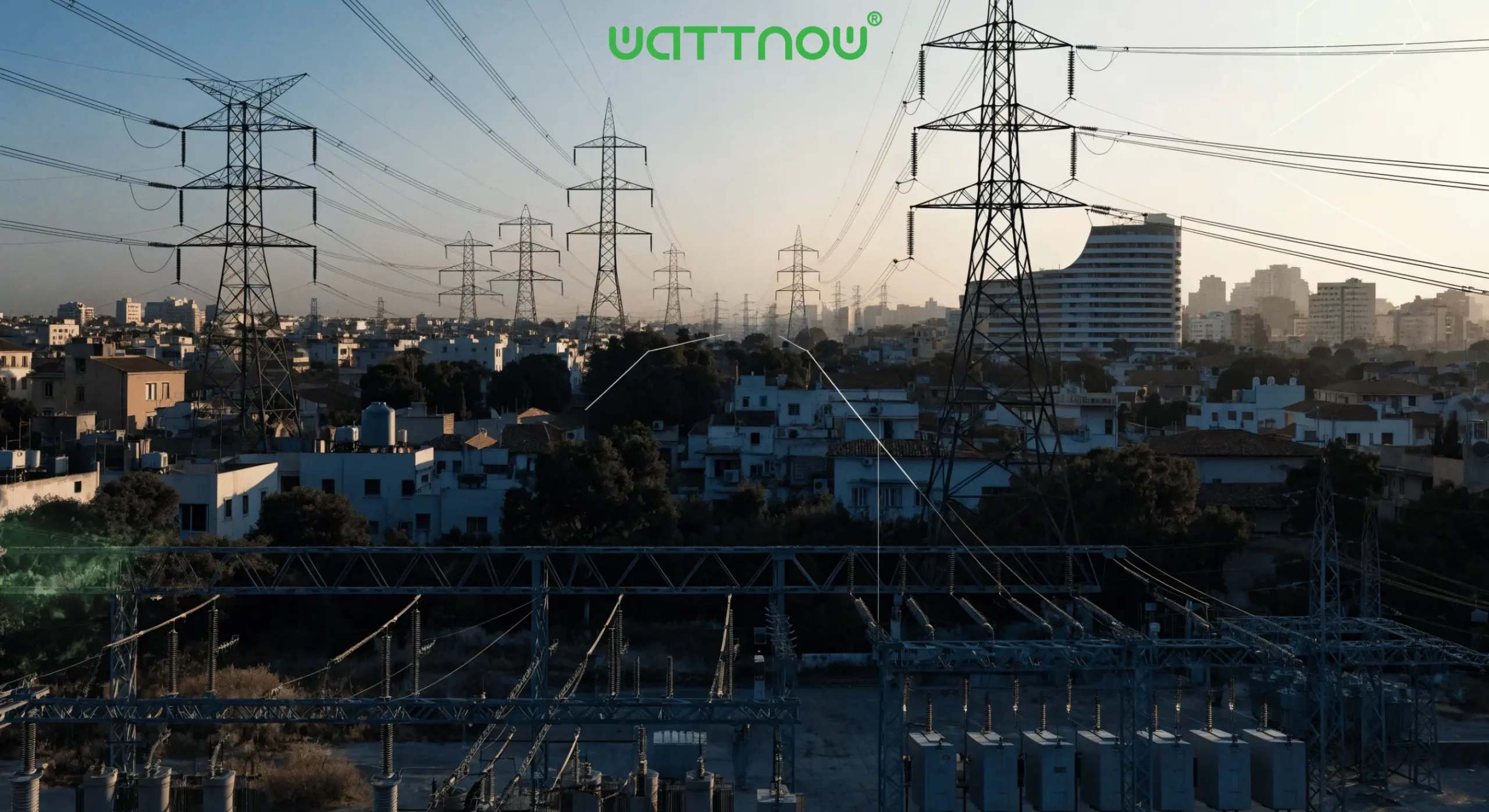
Every summer, electricity demand in Tunisia reaches its highest levels and puts the national grid under pressure. This article breaks down the causes of power outages, the role of STEG, and the solutions that strengthen the energy resilience of the country and its businesses.
Key takeaways
- Power outages in Tunisia mainly happen when national demand, driven up by air conditioning during heatwaves, exceeds available supply.
- STEG manages these peaks through continuous grid monitoring and, as a last resort, controlled load shedding to protect the system.
- The sustainable lever is not only producing more, but managing demand better: measure, anticipate, optimize.
- Smart Grids and energy management platforms like Wattnow help flatten peaks and strengthen resilience.
Electricity: a strategic national issue
Electricity powers the entire Tunisian economy: industry, services, retail, telecommunications, healthcare and the daily life of households. It is carried by a national grid operated by STEG, the Tunisian Company of Electricity and Gas.
Every summer, this grid faces its most critical moments. As temperatures climb, cooling needs rise simultaneously across the country. National demand then reaches record levels, and when it approaches the limits of available supply, the risk of outages increases.
📌 More than a technical matter: a stable electricity supply is a question of energy security, economic competitiveness and climate resilience. It underpins business continuity and the country's attractiveness.
Outages are therefore not an isolated incident, but a symptom of a deeper transformation of the energy system: rising consumption, a more extreme climate, ageing infrastructure to modernize, and the need for better demand management. Understanding these mechanisms is the first step to addressing them.
Why do power outages happen in Tunisia?
In short: an outage happens when instantaneous demand exceeds available supply, or when a technical incident hits a grid already under strain. In summer, air conditioning strongly amplifies this imbalance.
At the national scale, when the heat sets in, hundreds of thousands of air conditioners run at the same time. Each unit draws little, but their simultaneous use creates a wave of demand that the grid must absorb within a few hours, typically in the late afternoon and evening.
| Factor | Mechanism | Effect on the grid |
|---|---|---|
| Heatwaves | Massive, simultaneous use of air conditioners | Consumption peaks during summer peak hours |
| Infrastructure under strain | Generation, transmission and distribution near their limits | Higher risk of incident and cascading failure |
| Changing usage | Electrification, connected devices, urban and industrial growth | Structural rise in baseline demand |
| Gas dependence | Tunisia's electricity is generated overwhelmingly from natural gas | Sensitivity to energy supply and price pressures |
The strategic question is therefore no longer only "how do we produce more electricity?", but also "how do we better manage the electricity we already have?".
What role does STEG play in power outages?
In short: STEG generates, transmits and distributes electricity in Tunisia. During peaks, it monitors the grid continuously and may resort to controlled load shedding to prevent a widespread collapse.
During peak periods, the national operator uses several operational levers to preserve system stability.
Grid monitoring
Continuous tracking to spot heavily loaded areas, major swings in consumption and technical incidents, so the grid can be managed in real time.
Controlled load shedding
As a last resort, temporarily cutting supply to certain areas to protect equipment and maintain overall stability.
Protecting priority sites
Sensitive facilities (hospitals, essential services) are, in principle, given reinforced continuity.
Public communication
Informing consumers helps anticipate interruptions and encourages responsible use during critical hours.
What is load shedding?
Load shedding is a deliberate, temporary interruption of supply to part of the grid. It is a protective measure: it prevents a localized overload from triggering a much larger outage. It should not be confused with an unplanned outage caused by a technical fault.
What are the impacts of power outages?
In short: outages affect the economy (production stoppages, losses), buildings and retail (payments, cooling, comfort) and individuals (discomfort, disrupted remote work).
| Area | Main consequences |
|---|---|
| Economic (businesses) | Production stoppages, IT disruption, lower productivity, interrupted digital services. In some industries, a few minutes of downtime are enough to cause significant losses. |
| Buildings & retail | Payment systems down, cooling cut off, degraded working conditions |
| Social (individuals) | Discomfort during heat, disrupted remote work, connected devices offline |
Added up across the country, these impacts weigh on productivity, competitiveness and Tunisia's economic attractiveness. That is why the reliability of electricity is a key factor for businesses and investors alike.
From passive consumption to smart energy
In short: you cannot always control production, but you can better control consumption. Measuring in real time, anticipating peaks and optimizing usage eases the pressure on both the grid and the bill.
At their own scale, businesses have a direct lever: acting on their own consumption curve. Multiplied across many players, this control also relieves the national grid during critical hours.
Measure in real time
Smart meters and IoT sensors show when energy is consumed, which equipment weighs the most, and where the losses are.
Identify the peaks
Data analysis anticipates critical periods, flags energy-hungry equipment and inefficient behaviors.
Optimize usage
Management platforms cut unnecessary consumption, improve building efficiency and reduce costs.
💡 Go further: the principle of real-time monitoring is detailed in our guide to the Electrical Management System (EMS).
The role of Smart Grids in Tunisia's energy future
In short: a Smart Grid combines real-time data, AI, connected devices and automation to balance supply and demand, integrate renewables and strengthen resilience.
What is a Smart Grid?
A smart electricity grid uses sensors, data and automation to finely manage electricity flows. Unlike the traditional one-way grid, it communicates in both directions and adjusts continuously.
- Forecast consumption peaks
- Balance generation and consumption in real time
- Integrate more renewable energy
- Improve the overall resilience of the system
Tunisia has embarked on an energy transition strategy, driven notably by the development of renewables through the Tunisian Solar Plan and the gradual modernization of its grid. Smart technologies are one of its pillars.
The role of Wattnow
At Wattnow, we believe that energy data, IoT and digital intelligence are essential levers to help businesses understand, optimize and manage their consumption. In the face of summer peaks, this reduces load during critical hours and safeguards operations.
The platform measures consumption in real time, automatically detects anomalies and identifies savings. Companies that use it cut their energy costs by 10 to 30%, while staying on track for ISO 50001 compliance. Wattnow is deployed across more than 800 sites, on 4 continents, with teams in France and Tunisia.
Towards national energy resilience
Power outages in Tunisia reveal a challenge that is both national and global: adapting energy systems to growing demand and a more extreme climate. STEG's actions maintain grid stability during critical periods.
But the future also hinges on managing demand. Grid modernization, Smart Grids, renewables and intelligent consumption management are part of the same underlying shift towards a more reliable system.
For businesses, the path is clear: measure, anticipate and optimize. This is how they stop being at the mercy of peaks, protect their operations and contribute, at their scale, to a more resilient national grid.
Official resources
Read more (Wattnow articles)
Frequently asked questions
Mainly because instantaneous demand exceeds available supply, especially in summer when air conditioning creates peaks. Technical incidents on infrastructure under strain can also cause outages.
A deliberate, temporary interruption of supply to an area. It is a protective measure that prevents an overload from triggering a widespread outage.
By managing their demand: measuring consumption in real time, identifying peaks and optimizing usage. This reduces load during critical hours and limits costs.
An intelligent electricity grid that combines real-time data, artificial intelligence, connected devices and automation to balance supply and demand and better integrate renewables.
Stop being at the mercy of the next peak
Wattnow helps you measure, anticipate and optimize your energy to ease the pressure during peak hours.
Book a free demo