

Energy Anomalies: Toward Smarter Detection
🔎 Two concrete examples: in an office, lights on at 3 a.m. represent a contextual anomaly. In an industrial cold room, a 20% drop in electricity consumption during full production is a point anomaly invisible to a fixed threshold.
The 3 types of energy anomalies
In data science, three main families of anomalies are distinguished. To understand clearly, let's take two concrete examples: office lighting (tertiary sector) and an industrial cold room (industrial sector).
1. Point anomaly
A single observation that differs strongly from other values.
Tertiary example (lighting):
A faulty ballast causes a sudden drop in consumption:
500 W (normal) → 5 W (abnormal) for 15 minutes.
→ The office suddenly consumes much less, a sign of malfunction.
Industrial example (cold room):
A compressor that stops abruptly:
45 kW (normal) → 5 kW (abnormal) for 10 minutes.
→ Risk of temperature rise and loss of goods.
2. Contextual anomaly
A normal value in one context becomes abnormal in another (day/night, summer/winter, production/stop).
Tertiary example (lighting):
500 W at 2 p.m. = normal (office occupied).
500 W at 3 a.m. = abnormal → lights left on.
Industrial example (cold room):
35 kW during production day = normal.
35 kW at night (production stopped) = abnormal → insulation fault or door left open.
3. Collective anomaly
Each value taken individually seems normal, but the entire sequence is abnormal.
Tertiary example (lighting):
A corridor where the light normally comes on every 5 minutes.
If this cycle repeats all night (faulty presence detector) → the sequence is abnormal.
Industrial example (cold room):
Stable consumption at 45 kW with a regular defrost cycle.
If defrost cycles disappear and consumption gradually drops to 35 kW over 48 hours → risk of icing and loss of goods.
📐 Key lesson: a fixed-threshold alarm cannot detect contextual anomalies (e.g., lights left on at night) or collective ones (e.g., cold room drift). Only an intelligent approach, understanding the context, can do so.
Why fixed thresholds fail
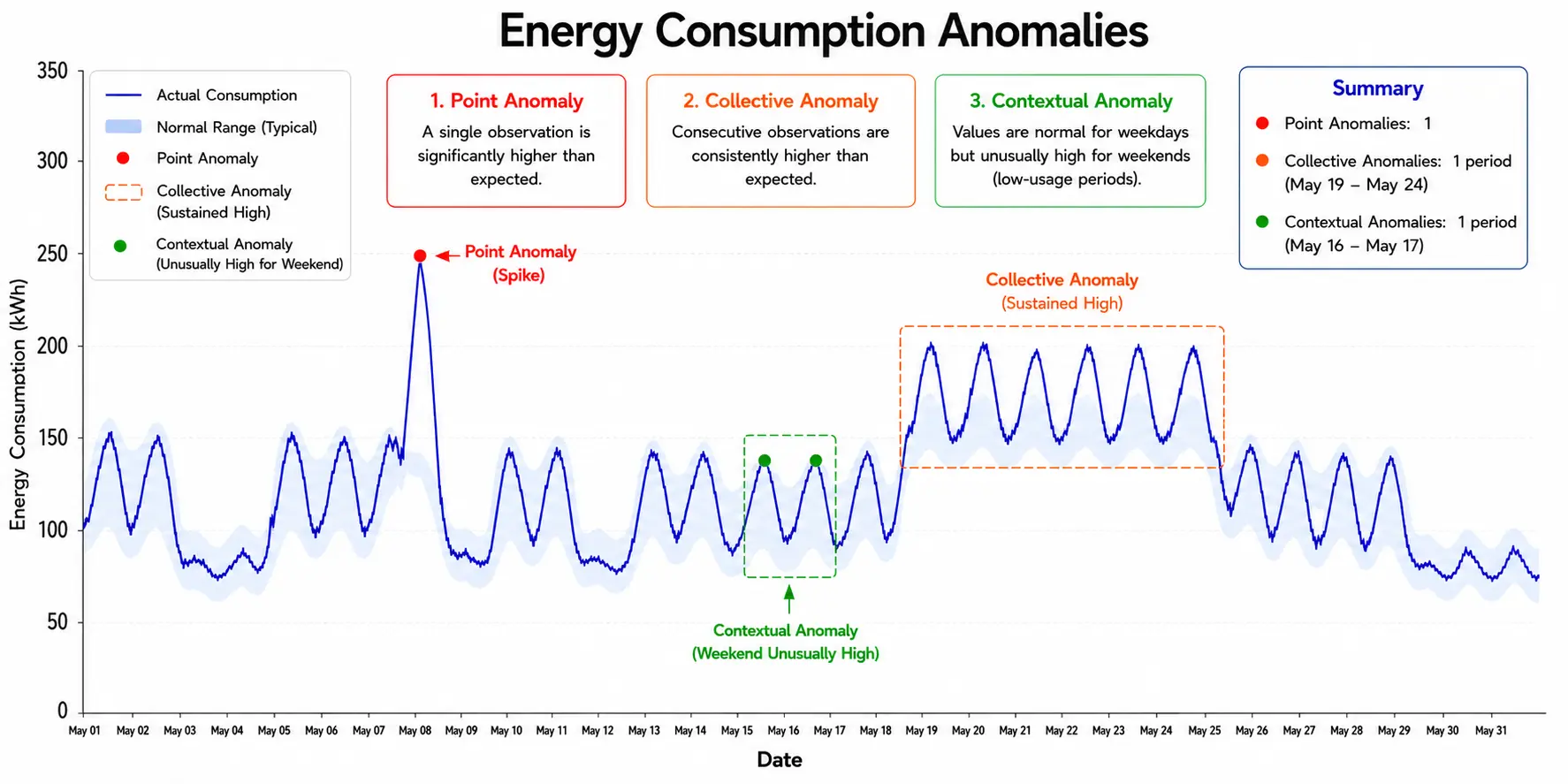
Figure 1: The three types of anomalies in an electricity consumption curve
Most alarm systems use fixed thresholds (e.g., alert if power > 100 kW or < 10 kW). Although simple, this approach suffers from two major flaws.
Problem #1: cascading false alerts
If the threshold is too low → nuisance triggers. Teams end up ignoring alerts.
With office lighting: a low threshold at 100 W. During the day, consumption sometimes drops below 100 W (no one in the zone) → alert. At night, abnormal consumption at 200 W (lights left on) triggers no alert because it remains above the low threshold.
With the cold room: a high threshold at 60 kW. In summer, consumption normally exceeds 65 kW (outside heat) → constant alerts. In winter, a consumption drop to 35 kW (defrost fault) triggers no alert.
Problem #2: completely invisible anomalies
A value may be normal in one context but abnormal in another. Fixed thresholds capture neither context nor gradual drifts.
With lighting: 500 W at 2 p.m. = normal. 500 W at 3 a.m. = abnormal (lights left on).
With the cold room: 45 kW during production = normal. 45 kW during production stop = abnormal (insulation fault or parasitic consumption).
📐 The bottom line: fixed thresholds generate either too many false alerts (alerts ignored) or too many missed detections (anomalies not detected). In either case, the system fails its mission and energy waste continues.
The cost of undetected anomalies
In tertiary buildings and industrial facilities, consumption anomalies represent significant waste often invisible:
- Lights left on: hundreds of euros per year for a simple parking lot or office
- Gradual drifts: aging equipment increasing consumption
- Control defects: misconfigured regulation, incorrect scheduling
- Abnormal baseline: too high base consumption at night or during production stops
According to the ACEEE (American Council for an Energy-Efficient Economy), energy management systems integrating machine learning can significantly reduce building energy consumption.
Concrete example:
- Office: lights on all night → +1000 kWh/year
- Cold room: compressor drift → +5000 kWh/year
Toward smarter detection
Understanding context
The intelligent approach learns the "normal behavior" of each piece of equipment and zone. For lighting, it knows that at 2 p.m., 500 W is normal; at 3 a.m., it's an anomaly. For the cold room, it knows that 45 kW during production is normal; 45 kW during a stop is abnormal.
Detecting gradual drifts
A 1% monthly increase in lighting consumption or a gradual decrease in cold room consumption remains invisible to a fixed threshold, but an intelligent approach detects this trend within the first few weeks.
Reducing false alerts
By integrating context (occupancy schedule, holidays, seasons, production cycles), the intelligent approach reduces nuisance alerts and allows teams to focus on real anomalies.
Example 1: Office lighting
The intelligent approach integrates:
- Occupancy hours (8 a.m. - 7 p.m.)
- Holidays and weekends
- Seasonality (sunlight)
Result: an alert only when consumption deviates from expected behavior.
Example 2: Industrial cold room
The intelligent approach integrates:
- Production and stop cycles
- Defrost cycles
- Outside temperature (seasonality)
Result: early detection of drift (e.g., icing) before it impacts the goods.
Our research work on anomaly detection
Wattnow conducts active research on energy anomaly detection. Our work is presented at international conferences and published in academic journals.
Our recent publications
Comparative analysis of available methods for energy consumption anomaly detection
Conference: 2024 10th International Conference on Automation, Robotics and Applications (ICARA)
Abstract: A comparative study of existing methods for anomaly detection in energy consumption, evaluating their performance on real data from tertiary buildings and industrial facilities.
Toward unsupervised detection of energy consumption anomalies
Conference: AIAI 2024 (Corfu, Greece)
Abstract: An unsupervised approach to anomaly detection, not requiring pre-labeled examples, particularly suitable for industrial environments where anomalies are rare and varied.
Defect detection in electroluminescence images of photovoltaic panels using lightweight variants of YOLOv9 to YOLOv12
Conference: 2025 25th International Conference on Digital Signal Processing (DSP)
Abstract: Automatic defect detection in photovoltaic panels from electroluminescence images, using lightweight YOLO variants for fast and efficient field inspection.
International conferences
10th International Conference on Automation, Robotics and Applications
Athens, Greece, February 2024
Corfu, Greece, 16 October 2024
Applications of Artificial Intelligence to anomaly detection
Istanbul, 18-19 October 2024
Pattern Recognition in Energy
25th International Conference on Digital Signal Processing
Greece, June 2025
📐 A recognized approach: Wattnow deploys its models on a secure and scalable AWS infrastructure. The company commits to ethical data use, relying solely on public, licensed, or customer-authorized data. → Discover Wattnow's Research & Development page
Documented field results
Wattnow integrates smart detection approaches into its energy monitoring platform. Results from our customer base:
Detection of off-hours consumption (lighting, heating, air conditioning)
Identification of drifts in cold rooms, compressors and production lines
Automatic comparison between sites and detection of relative anomalies
📊 Field result: Wattnow customers detect and correct anomalies that remained invisible with classical approaches, generating significant savings on their energy bills.
Frequently asked questions about energy anomaly detection
A point anomaly is an isolated abnormal value (e.g., sudden drop in consumption). A contextual anomaly is a normal value in one context but abnormal in another (e.g., lights on at night or a cold room consuming during production stop).
Because they do not differentiate between normal daytime consumption and abnormal nighttime consumption, nor between normal production behavior and abnormal stop behavior. An intelligent approach, on the other hand, understands the occupancy or production context.
Wattnow has published work on comparative analysis of detection methods (ICARA 2024), unsupervised detection (AIAI 2024) and defect detection in solar panels (MedPRAI24).
By integrating context (occupancy hours, holidays, seasons, production cycles, history), it avoids triggering alerts for normal but variable behaviors.
Additional resources
Detect your energy anomalies
Wattnow helps you identify abnormal consumption (lights left on, cold room drifts, etc.) through an intelligent, context-aware approach.
Schedule a discussion