

Industrial Steam: complete guide to mastering your energy costs
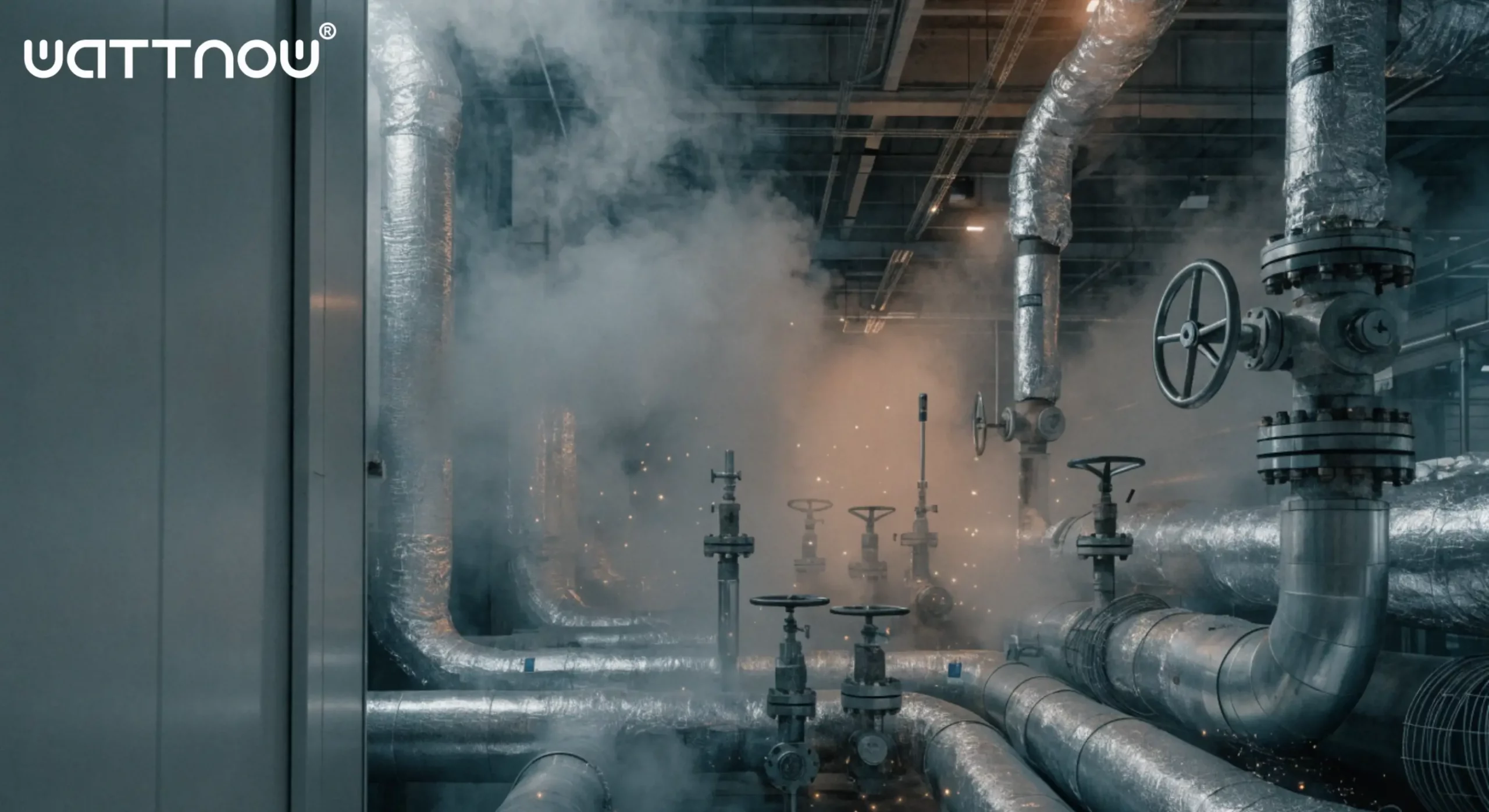
In many factories, steam is the second largest energy carrier after electricity. Yet between 15 and 30% of this energy escapes every day ; through failed steam traps, uninsulated pipes, unnecessary superheat. And often, no one knows it.
In brief: A single stuck-open steam trap can waste up to 50,000 kWh/year. Multiply that by 50 traps on a site… and you have the equivalent of a neighborhood's electricity consumption. Good news: 80% of these losses are detectable and fixable.
What is industrial steam and why is it so expensive?
Industrial steam is a dense energy carrier capable of transporting enormous power over long distances. In food processing, chemical, or pharmaceutical plants, it's used for sterilization, drying, heating reactors, or driving turbines.
But this convenience comes at a price: producing 1 ton of saturated steam at 10 bar requires approximately 660 kWh of primary energy. At 2026 prices, this represents between $55 and $85 per ton depending on the fuel.
Check out our industrial steam technical manual.
Order of magnitude
For a plant consuming 10,000 tons of steam per year, the bill exceeds $1 million. At 20% losses, that's $200,000 wasted annually, often without anyone knowing.
How is industrial steam produced?
Before understanding losses, you need to understand what you're producing. Industrial steam isn't boiling water ; it's a high-density energy carrier, and its production cost depends directly on the boiler type and operating pressure.
Hot gases pass through tubes
Most common technology in light industry. Max pressure ~18 bar. Ideal for 200 to 5,000 kW. Efficiency: 82–88%.
Water circulates through tubes
For high pressures (20–100+ bar) and large capacities. Cogeneration, chemical, pulp & paper. Efficiency: 88–93%.
Which steam for which process?
Saturated steam suits 80% of industrial applications. Superheated steam is reserved for turbines and costs 8–12% more to produce.
Key enthalpy point: at 10 bar, saturated steam contains approximately 2,778 kJ/kg. An uninsulated 200-meter pipe can dissipate up to 200,000 kWh/year through radiation alone.
The 5 main sources of steam system losses
Failed steam traps
A stuck-open steam trap = continuous live steam leak. Loss: 20,000 to 50,000 kWh/year per trap. 10% of traps are failed without being noticed.
Pipe leaks and fittings
A 3 mm orifice at 7 bar wastes 10,000 kWh/year. Leaks account for 5–15% of total losses.
Unrecovered condensate
Every liter of condensate discharged is wasted energy. Recovering condensate can save 10–20% of boiler fuel.
Excessive superheat
Producing superheated steam when not needed means 8–12% extra energy consumption.
Degraded insulation
One meter of uninsulated pipe at 180°C dissipates 1,000 kWh/year. Over 200 meters = 200,000 kWh/year lost.
"During our audit, we discovered that 18% of our steam production was lost through failed steam traps. Within 3 months after replacements and Wattnow monitoring, we reduced our gas bill by 22%."
Sankey diagram: where does your steam energy really go?
Toggle between "Before" and "After optimization" to visualize the impact of corrective actions - replaced steam traps, condensate recovery, improved insulation.
What the Sankey reveals
- 100% of energy enters the boiler
- ~15% losses from combustion and stack
- ~18% losses from failed steam traps (before)
- ~10% losses from pipe leaks and condensate
- Only 40% actually reaches the process
The goal: increase process efficiency from 40% to 72% by correcting identified losses ; without changing any production equipment.
Go further with Sankey diagrams:
Sankey diagram - visualize & optimize (EN) Guide complet - diagramme de Sankey (FR)Continuous steam system monitoring: what Wattnow measures
A one-time audit detects yesterday's problems. Continuous monitoring detects today's problems - before they become invoices.
Steam & condensate flow meters
Real-time consumption tracking by production line, detection of drifts and leaks through flow balance analysis.
Steam trap failure alerts
Identification of stuck-open or stuck-closed steam traps ; before the next scheduled maintenance shutdown.
Dedicated steam dashboard
Losses by source, enthalpy efficiency, EnPI indicators compliant with ISO 50001.
Native industrial protocols
Modbus, MQTT, 4-20 mA, PT100 connectivity ; compatible with your existing sensors. Non-intrusive deployment in under 4 weeks.
Optimizing your steam system: a complete approach
1. Energy audit
Energy audit to map your network and prioritize actions by ROI.
2. Steam KPIs
Track your key indicators: specific consumption (kWh/ton steam), boiler efficiency, condensate return rate.
3. ISO 50001
Discover how ISO 50001 structures your continuous improvement approach.
Frequently asked questions about industrial steam
A steam trap automatically discharges condensate without letting steam escape. A failed steam trap can waste up to 50,000 kWh/year — several thousand dollars per trap.
The 5 major sources: failed steam traps (15–25% of losses), pipe leaks, unrecovered condensate, excessive superheat, and radiation losses from degraded insulation.
Saturated steam is at equilibrium at a given pressure (e.g., 184°C at 10 bar). Superheated steam exceeds this temperature — necessary for turbines, but 8–12% more expensive and unnecessary for most process heating applications.
By installing IoT sensors (flow, pressure, temperature) on the network, Wattnow continuously analyzes data, automatically detects anomalies, and alerts teams for immediate correction. Check out our real-time monitoring solution.
An audit is a one-time diagnosis (mandatory every 4 years for large companies). An Energy Management System (EnMS) provides continuous monitoring, maintains performance, and meets ISO 50001 requirements.
Further reading
Ready to take control of your steam system?
Don't let 20% of your energy evaporate into invisible losses. Wattnow helps you detect, act, and measure your savings ; starting from the first weeks.
Request a free demo