

HDD: What Energy Managers Really Need to Know
Key Takeaways
- HDD assumptions are often violated (linearity, constant setpoints, no inertia)
- Uncertainty range: 15-20% before accounting for metering errors
- Alternative approaches: multivariate regression, machine learning, dynamic models
- ISO 15927-6 and ASHRAE Guideline 14 provide methodological frameworks
Heating Degree Days have become a standard tool in energy management. However, their common usage relies on assumptions that are rarely questioned. This article provides a critical analysis of HDD: methodological biases, interpretation limits, and how to overcome them for truly reliable energy monitoring.
⚠️ For practitioners: Beyond simple weather correction, understanding the blind spots of HDD helps avoid diagnostic errors and refine energy performance models.
The implicit premise of HDD
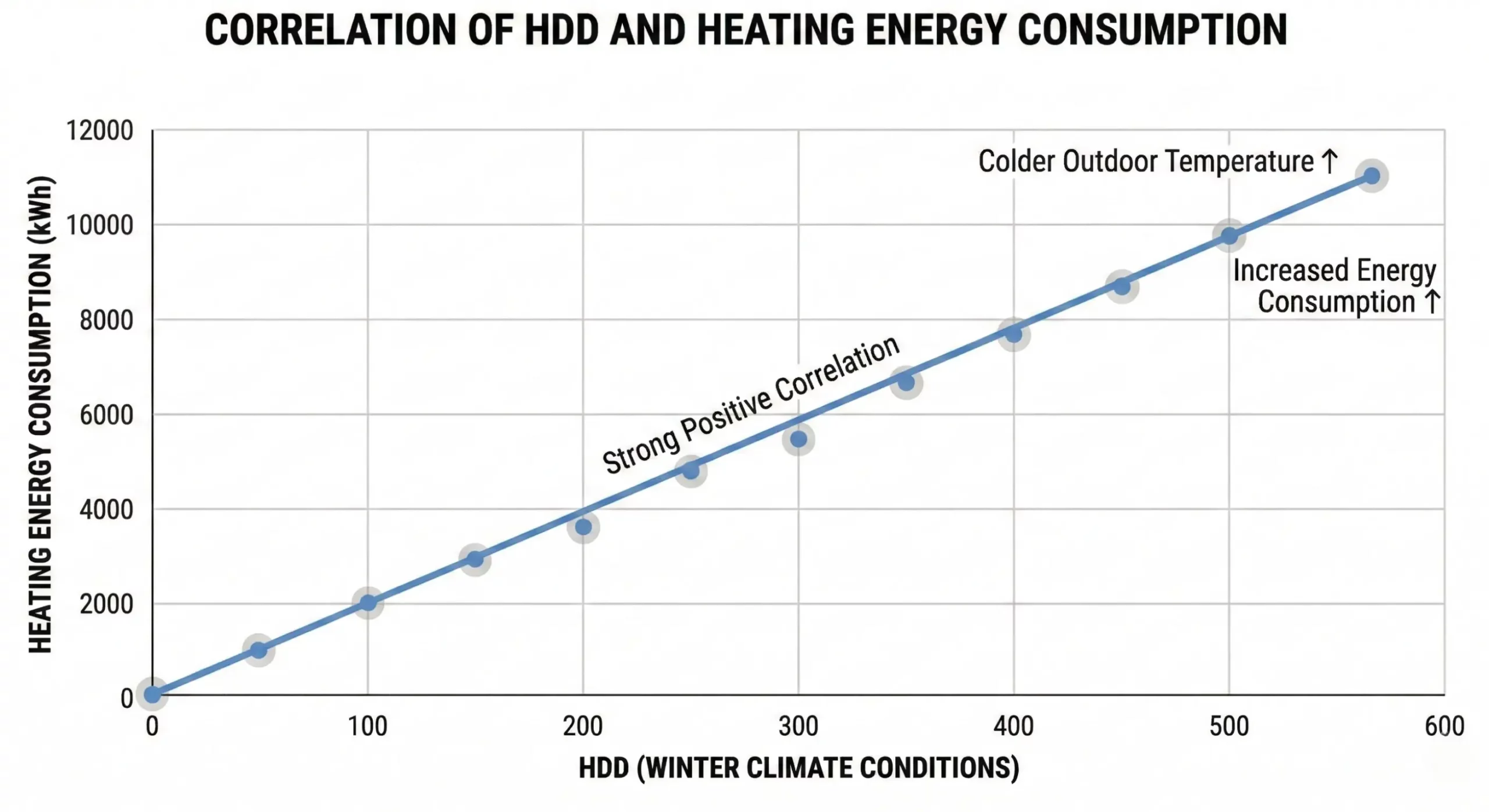
The use of HDD relies on a strong hypothesis: energy consumption is proportional to the difference between outdoor and indoor temperature. This assumption deserves examination.
Assumed Linearity
The HDD model assumes that each additional degree of difference generates the same additional consumption. However, equipment efficiency (heat pumps, boilers) varies with outdoor temperature. Modern boilers with weather compensation curves break this linearity.
Neglected Inertia
The daily calculation assumes an instantaneous response from the building. In reality, thermal inertia shifts and smooths the impact of climate variations. A 3-day rolling average often provides better correlation.
Ignored Free Gains
HDD accounts for neither solar gains nor internal gains (occupancy, equipment), which are significant in high-performance buildings. This can lead to underestimation of energy needs in well-insulated structures.
📚 Reference: ISO 15927-6:2007 defines degree-days but acknowledges these limitations. For detailed methodology, see ASHRAE Guideline 14-2014 (section on regression methods).
Five rarely discussed limitations
A critical look at the blind spots of the HDD indicator.
The conventional 18°C base for heating dates from an era when buildings were less insulated and setpoints were higher. Today, many buildings are heated to 19°C during occupancy and 16°C during unoccupied periods. A single base temperature for the entire season masks these variations. The error can reach 15% in the calculation of theoretical needs.
HDD only considers dry-bulb temperature. However, comfort perception and heating needs also depend on humidity and solar radiation. Two days with the same HDD can generate very different consumption levels if one is sunny and the other humid.
Modern boilers and heat pumps modulate their power and efficiency based on outdoor temperature. The relationship between consumption and HDD is therefore not linear: in extreme cold, efficiency may drop, increasing consumption per HDD. Simple models do not capture these threshold effects.
HDD calculation assumes a constant indoor temperature. In reality, it fluctuates based on occupancy, internal gains, and occupant behavior. An overheating building will consume more than HDD predicts, but this excess might be interpreted as a drop in performance rather than a setpoint issue.
HDD are calculated from weather stations sometimes far from the site. In urban areas, the heat island effect can cause a difference of 2 to 3°C compared to the peripheral station, resulting in a 20 to 30% error in cumulative HDD.
How to overcome these limits?
Recommendations for an informed use of HDD from ISO, ASHRAE, and ADEME guidelines.
Best practices
- 1 Use dynamic base temperatures: Calibrate the base temperature according to actual setpoints (occupied/unoccupied) and the season.
- 2 Integrate complementary variables: Add sunshine, humidity, or a 3-day rolling average temperature to account for inertia.
- 3 Switch to multi-parameter models: Multiple linear regression (HDD + sunshine + occupancy) offers better explanatory power than the simple ratio (ASHRAE Guideline 14).
- 4 Qualify the weather data source: Check the distance to the station, its environment, and prioritize data from gridded models or reanalysis for remote sites.
⚙️ How Wattnow addresses these challenges: Our platform uses multivariate regression models integrating sunshine and occupancy, intelligent selection of weather sources (nearest station or gridded data), and detection of setpoint changes to avoid false alerts.
Frequently Asked Questions
Indirectly, yes, provided you have a detailed model. After correcting for HDD, sunshine, and inertia, the residuals can reveal changes in behavior (window opening, setpoint adjustments). But HDD alone is not sufficient.
Studies estimate the uncertainty related to the choice of weather station between 5 and 15% depending on distance and topography. Uncertainty due to the fixed base temperature can add 5 to 10%. In total, a kWh/HDD ratio has an uncertainty on the order of 15-20% before even considering metering errors.
Yes, multi-variable regression models (temperature, humidity, radiation, occupancy) offer better accuracy. Neural networks and machine learning are starting to be used for complex building portfolios. Dynamic digital twins simulate thermal behavior hour by hour. Refer to ASHRAE Guideline 14 for statistical methods.
Wattnow uses a hybrid approach: HDD correction for standard indicators, but also advanced regression models for in-depth analysis. The platform allows you to visualize uncertainty and test sensitivity to the choice of base temperature and weather source.
Related articles from Wattnow
In summary
HDD remain a valuable tool, provided their limitations are understood. Savvy Energy Managers don't settle for a raw ratio: they question the method, test sensitivities, and enrich the analysis with other variables. The maturity of an energy management system is also measured by its ability to go beyond simplified indicators. For robust energy performance monitoring, combine HDD with multivariate regression and quality-check your weather data sources.
An expert look at your data
Discover how Wattnow combines HDD, advanced modeling, and data intelligence for energy management that goes beyond simplistic indicators.
Request a demo