

Directive (EU) 2023/1791: take action starting in 2026 to meet the new requirements
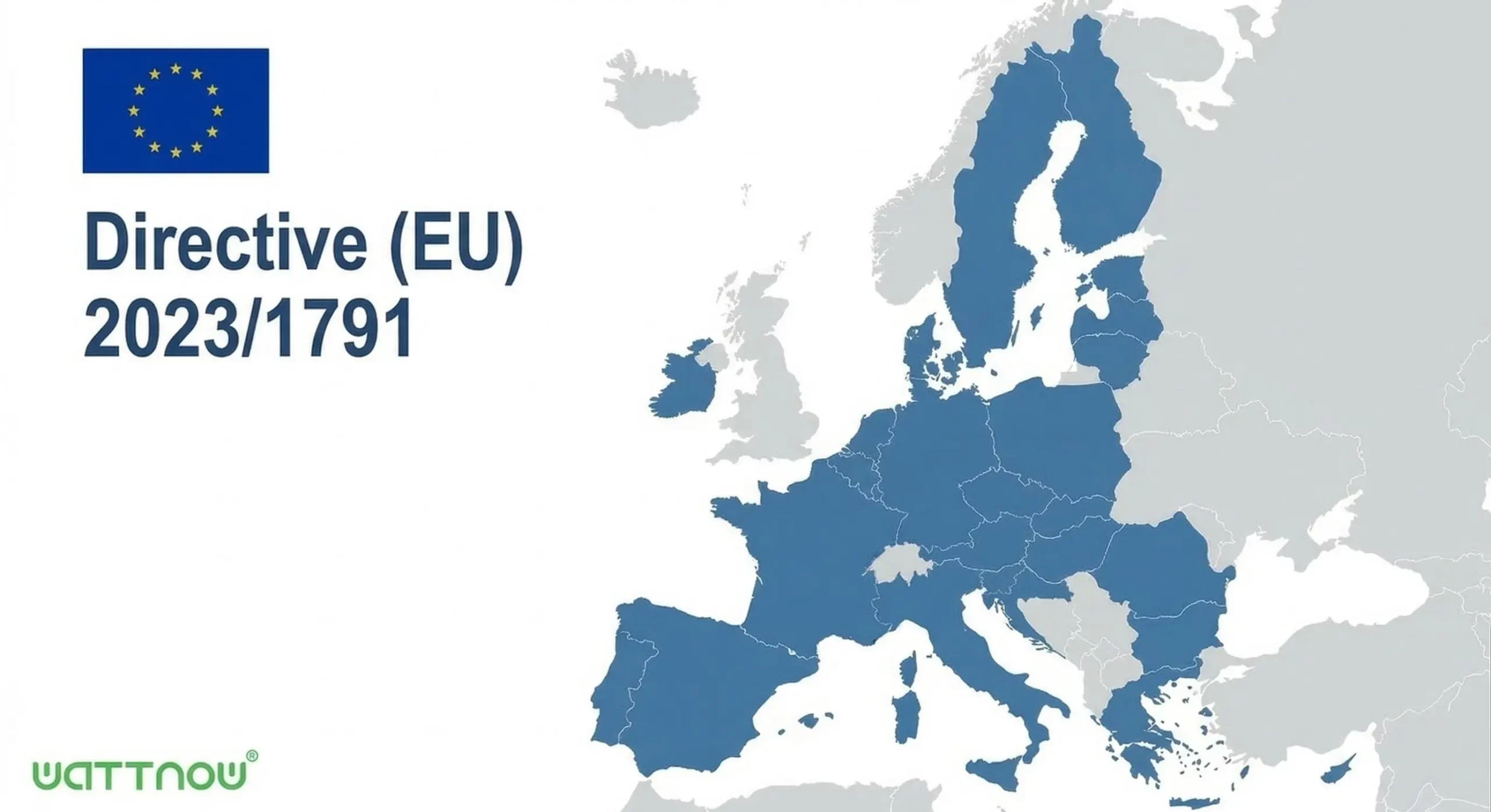
Directive (EU) 2023/1791, which entered into force in October 2023, was required to be transposed into national laws by October 11, 2025. In 2026, the focus is on compliance: companies must now apply the new rules (energy management systems, enhanced audits) and contribute to the 2030 targets.
🔎 For businesses and public authorities in 2026: The transposition deadline has passed. It is now crucial to check the published national texts and undertake the necessary actions: implementing an EnMS, monitoring energy savings, and reporting. Non-compliance may lead to penalties.
A strengthened climate ambition: the foundation of the directive
Directive 2023/1791 is part of the legal framework of the Green Deal and the European Climate Law, which make the goal of climate neutrality by 2050 binding.
European Climate Law
Adopted in 2021, it enshrines the target of reducing GHG emissions by at least 55% by 2030 (compared to 1990) and climate neutrality by 2050. The energy efficiency directive is a key instrument for achieving these goals.
"Energy Efficiency First" Principle
For the first time, this principle gains binding legal value. It means energy efficiency must be systematically considered first in all major policy and investment decisions, in the energy sector and beyond.
A raised and binding 2030 target
The directive sets a collective target to reduce final energy consumption to 763 Mtoe and primary consumption to 992.5 Mtoe by 2030. This represents an 11.7% reduction compared to the 2020 reference scenario. National contributions are indicative but a catch-up mechanism is foreseen.
Sources: European Climate Law · Green Deal
The 3 pillars of the revised directive
1. Binding consumption targets
Caps on final (763 Mtoe) and primary (992.5 Mtoe) energy consumption not to be exceeded at the European level in 2030. Member states set indicative contributions based on objective criteria (energy intensity, GDP, saving potential).
2. Annual energy savings obligation
The obligation for member states to achieve new energy savings each year is more than doubled. It increases to 1.3% (2024-2025), 1.5% (2026-2027) and 1.9% (2028-2030) of final consumption. Measures should primarily target vulnerable consumers.
3. Expanded audit obligations
Large companies retain the energy audit obligation. The new feature is the obligation to implement an energy management system (EnMS) for large industrial consumers. SMEs with high saving potential may also be concerned.
📅 Implementation timeline - 2026 Update
What the directive concretely changes for companies this year
With transposition officially behind us, companies must now take action. Here are the measures to implement without delay.
Energy Audits & EnMS: strengthened obligation
Large companies can no longer rely solely on a quadrennial audit. The directive now requires, through national transpositions, the implementation of certified energy management systems (EnMS) (e.g., ISO 50001) to continuously manage and improve their performance. In 2026, authorities are beginning to monitor compliance.
Building renovation: acceleration
The 3% annual renovation obligation for public administration buildings is maintained and expanded. Companies are encouraged, via national plans and the Social Climate Fund, to accelerate the energy renovation of their real estate portfolios. Financial aid is available.
Data centers: mandatory transparency in 2026
Facing the explosive growth of their consumption, data centers will need to publish key data on their energy performance. The legislative package expected in March 2026 will define thresholds and minimum efficiency standards. Preparation is crucial now.
Fighting energy poverty
A portion of the energy savings achieved through the annual obligation must be directed towards vulnerable households. This translates into support schemes, advice, and easier access to renovation financing, representing a market for building and energy companies.
The 5 essential points to remember in 2026
How Wattnow helps you meet the directive's requirements in 2026
Our EMS (Energy Management System) platform is the ideal tool to implement a high-performance energy management system, track your savings, and comply with reporting obligations.
Implementing an EnMS (ISO 50001)
Wattnow digitizes your energy management system. Automatic data collection, calculation of performance indicators (EnPIs), tracking of action plans, and generation of management reviews. A solid foundation for ISO 50001 certification, meeting the directive's requirements.
Tracking energy savings (1.5% obligation)
Measure and prove your energy savings in real-time thanks to our correction algorithms (weather, production). Ideal for justifying your contribution to the annual energy savings obligation and showcasing your efficiency efforts to authorities.
Reporting and transparency for data centers
Automatically generate necessary reports for administrations, investors, or the public. For data centers, Wattnow prepares the performance indicators (PUE, etc.) that will be required by the March 2026 legislative package.
⚡ Wattnow, a partner for your 2026-2030 roadmap
Beyond compliance, Wattnow helps you turn these obligations into performance levers, by identifying savings opportunities and automating equipment management to sustainably achieve consumption reduction targets.
Frequently asked questions about the Energy Efficiency Directive in 2026
2026: Ensure compliance with Wattnow
The transposition date has passed. Don't face a compliance check unprepared. Our experts help you implement an effective energy management system and meet the directive's requirements.
Discuss your compliance strategy
One Response