

Electrical Load Curve: complete guide to analyze and optimize your consumption
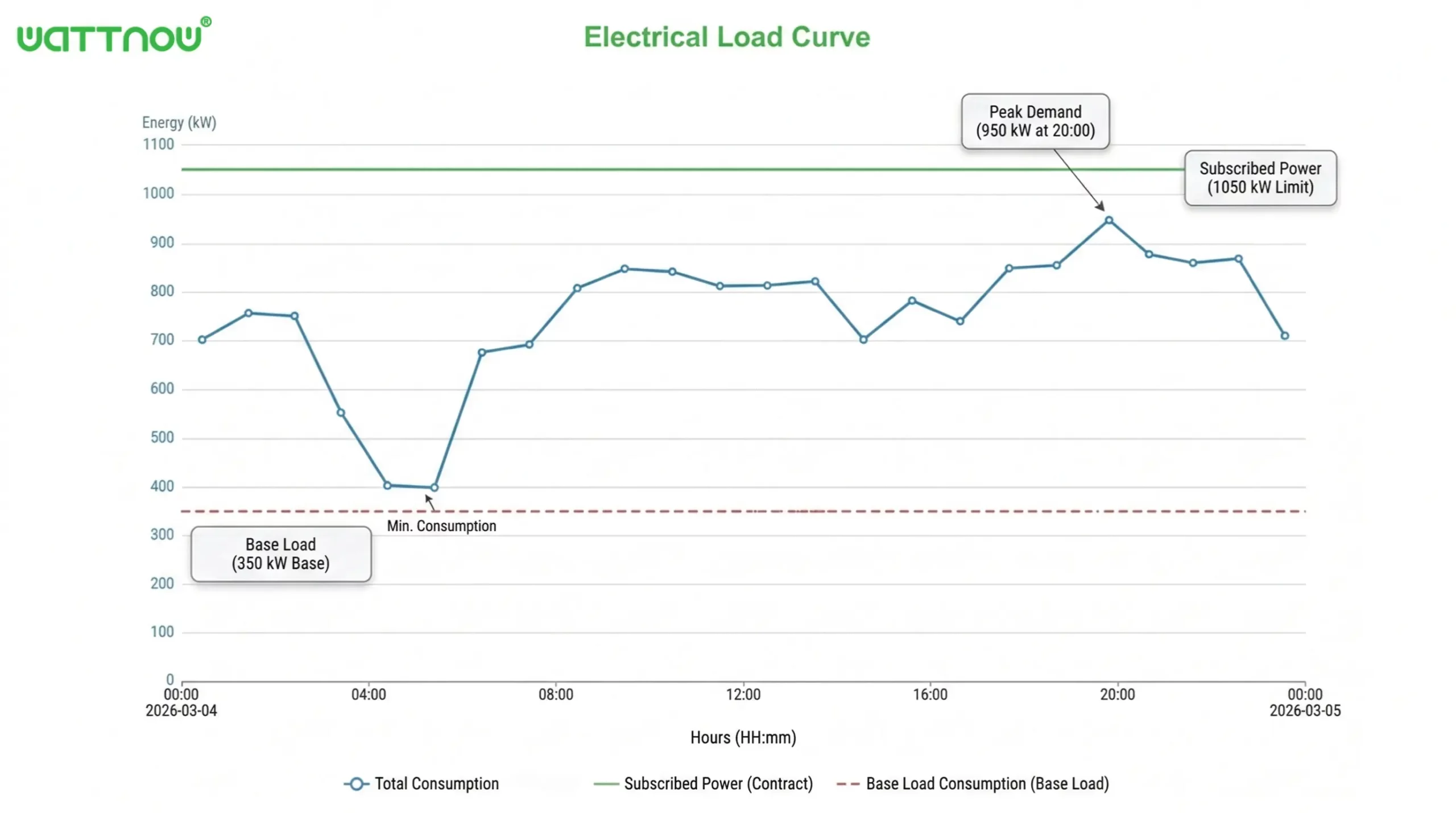
The load curve is the X-ray of your electricity consumption. It represents the evolution of your power demand (in kW) over time, at regular intervals (10, 30, or 60 minutes). Load curve analysis is a strategic tool to control costs, avoid overrun penalties, and optimize your electricity contract.
🔎 In short: Interpreting your load curve helps identify your base load (residual consumption), your power peaks (to be smoothed), and adjust your subscribed power. A well-conducted load curve analysis can generate 10 to 30% savings on your bill.
What is an electrical load curve?
Unlike a monthly consumption index, the load curve offers a dynamic and granular view of your electricity usage. It is the fundamental tool for any in-depth load curve analysis.
A measurement at fixed time steps
The load curve records your electrical power (in kW) at regular intervals. The shorter the time step (10 minutes), the more precise the load curve analysis is for detecting anomalies and fleeting peaks.
For which professionals?
Accessible for all professionals equipped with smart meters (Linky, PME-PMI). The load curve is essential as soon as your power exceeds 36 kVA, and consulting it is crucial for optimizing your subscribed power.
Why analyze your load curve?
Because your electricity bill depends not only on your total consumption (kWh), but also on your power demand (kW) and how you use the grid. Load curve analysis reveals this hidden information and optimization opportunities.
The car analogy
kW (power) = instantaneous speed. It's the intensity of the effort demanded from the engine at a given moment.
kWh (energy) = distance traveled. It's the total consumption over a trip.
Your load curve is the speedometer of your business. Load curve analysis tells you when you are driving too fast (costly peaks) and when you are leaving the engine idling unnecessarily (base load).
How to get your load curve with Wattnow?
Automatic and centralized collection
Wattnow simplifies access to your load curves. After simple digital consent, our secure APIs connect directly to your smart meter (Linky, PME-PMI). No more manually downloading Excel files or making requests to multiple contacts. Load curve analysis becomes an automated process.
What Wattnow brings to your curve analysis:
- Centralization of all your sites on a single interface
- Near-real-time data, updated automatically
- Custom alerts for power exceedances or base load drift
- Automatic analyses: base load, peaks, subscribed power adequacy
- Easy export and sharing for audits or your teams
With Wattnow, load curve analysis becomes an active management tool, not just a history consulted once a year.
Compatible with all smart meters (Linky, PME-PMI) and major metering technologies.
The 4 hidden insights in your load curve
A methodical load curve analysis reveals unexpected savings opportunities. Here are the four key indicators to interpret.
1. The base load
What is it? The minimum power demanded 24/7, even at night and on weekends. It's the permanent "fever" of your site, a key indicator in load curve analysis.
What it reveals: An abnormally high base load can hide forgotten standby equipment, poorly adjusted air conditioning, oversized servers, or compressed air leaks.
Typical action: Program automatic shutdown of non-essential equipment outside production hours. A base load reduced by 10 kW is 10 kW × 24h × 365 days = 87,600 kWh of potential savings per year.
2. Consumption peaks
What is it? The moments when your power demand reaches its highest points, often during morning machine start-ups or simultaneous startups. Identifying peaks is essential in load curve interpretation.
What they reveal: If your peaks regularly exceed your subscribed power, you incur overrun penalties. If your peaks are significantly lower, your subscription is too high.
Typical action: Stagger the start-up of certain equipment by 30 minutes to smooth the curve. This is the basis of peak shaving.
3. Subscribed power adequacy
What is it? The contractual limit you must not exceed, under penalty of fines. Optimizing subscribed power is a major goal of load curve analysis.
What it reveals: By overlaying your curve with your subscribed power, you immediately see if you are "too tight" (frequent overruns) or "too loose" (oversized subscription).
Typical action: After 12 months of analysis, adjust your subscribed power to closely match your actual needs. A reduction of 100 kW can represent several thousand euros or dinars in annual savings.
4. Consumption drifts
What is it? Abnormal variations in the curve unrelated to activity (an unusual peak at 3 a.m., a gradual increase in the base load). Detecting drifts is a major benefit of load curve analysis.
What they reveal: A piece of equipment starting to malfunction, a regulation fault, or hidden overconsumption (compressed air leak, etc.).
Typical action: Trigger preventive maintenance before a breakdown. Detect overconsumption and correct it immediately.
Dashboard: indicators to monitor in load curve analysis
From load curve analysis to action: savings examples
🏭 Industry (France): peak shaving
Situation: A food processing plant recorded a morning peak of 850 kW every day, exceeding its subscribed power of 800 kW.
Load curve analysis: The peak was due to the simultaneous start-up of two production lines and extractors.
Action: Delayed the start of the second line by 20 minutes and controlled the extractors.
Result: Peak reduced to 780 kW, elimination of overrun penalties (estimated at €8,000/year) and saving of €4,000 on the subscription after renegotiating the subscribed power.
🏢 Commercial (France): base load reduction
Situation: A 10,000 m² office building had a base load of 45 kW at night and on weekends.
Load curve analysis: The curve showed unexplained constant consumption outside opening hours.
Action: Equipment audit: air conditioning left on, non-virtualized servers, oversized security lighting.
Result: Base load reduced to 22 kW, i.e., 23 kW × 5,000 hours/year = 115,000 kWh savings = €18,000/year.
🔧 Industry (Tunisia): anomaly detection
Situation: A Tunisian factory saw its STEG bill increase for no apparent reason.
Load curve analysis: The curve revealed a regular 100 kW peak in the middle of the night, absent in previous years.
Action: On-site investigation: a leaking air compressor was turning on every night to compensate for a leak.
Result: Leak repair (cost 200 TND) = 12,800 TND/year savings (equivalent to approx. €3,700).
Automate your load curve analysis
Our EMS platform collects, centralizes, and analyzes your load curves to alert you and recommend optimization actions. Continuous load curve analysis, without manual effort.
Multi-site centralization
View at a glance the load curves of all your sites, compare their performance, and identify anomalies. Large-scale load curve analysis.
Intelligent alerts
Receive a notification by email or SMS when your power approaches the subscribed limit, or when base load drift is detected. Real-time load curve interpretation.
Measurable ROI
Our reports quantify the savings achieved and help you adjust your contracts. Load curve analysis with Wattnow means an average return on investment of 8 to 14 months.
The 5 key points of load curve analysis
Frequently asked questions about load curve analysis
Sources and references
- Enedis - Understanding your load curve
- Commission de Régulation de l'Energie (CRE) - Technical documentation
- STEG - Société Tunisienne de l'Electricité et du Gaz
- ANME - Agence Nationale pour la Maîtrise de l'Energie
Last updated: March 2026. Consumption data varies by country and operator.
Automate your load curve analysis
Stop letting your consumption data sit idle in Excel files. Our platform transforms load curve analysis into actionable insights to sustainably reduce your bill, whether you are in France, Tunisia, or elsewhere.
Request a personalized demo