

Industrial Energy Pareto: How 25% of Your Equipment Consumes 75% of Your Energy
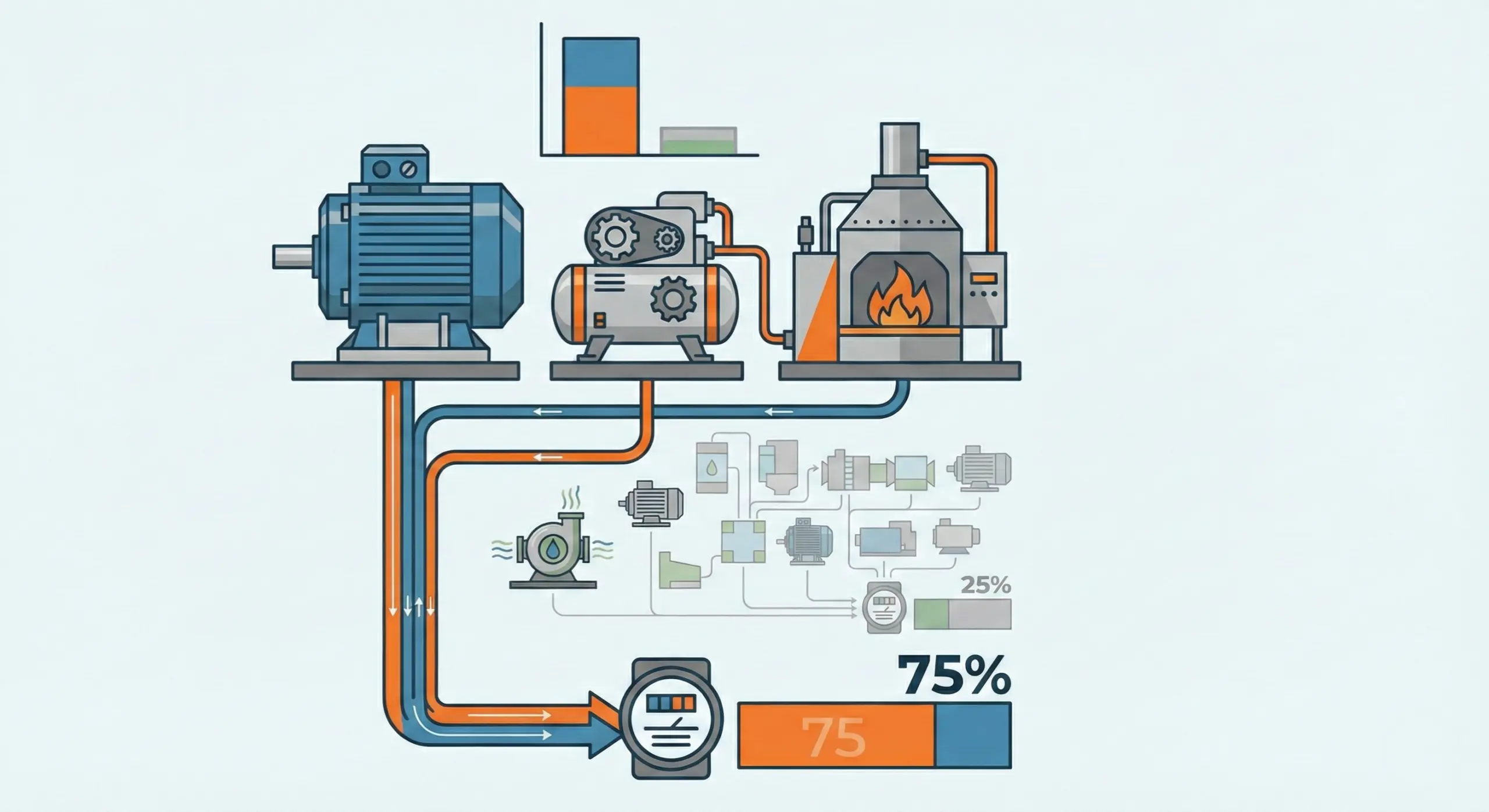
Pareto's law applied to energy reveals an undeniable reality: in most factories, 75% of energy consumption comes from only 2 usage families - thermal processes (55%) and mechanical power (20%). Mastering this principle means focusing your efforts where the impact is maximum.
The energy Pareto diagram is not just a theory: it's an operational tool that allows industrial companies to prioritize investments, accelerate decarbonization, and achieve substantial savings. With Wattnow, transform this analysis into measurable concrete actions.
Understanding the 75/25 Distribution of Your Consumption
Priority optimization target: 75% (Zone A)
Applying the Pareto principle to industrial energy management revolutionizes the optimization approach. Rather than scattering efforts across all consumption points, this scientific method identifies the 20-25% of "vital" equipment that generates 75-80% of consumption. For industrial sites, this analysis systematically reveals the predominance of thermal processes (55%) and mechanical power (20%). Wattnow digitizes this analysis to transform identification into measurable priority actions.
To complement this strategic analysis, discover how our platform facilitates the definition and monitoring of essential energy KPIs.
What is Industrial Energy Pareto?
The energy Pareto applies the 80/20 law (or 75/25 in our case) to energy consumption: a minority of equipment concentrates the majority of kWh consumed. This approach, originating from Vilfredo Pareto's work, is proven in quality, maintenance, and project management.
Scientific Prioritization
Objectively identify equipment deserving 80% of your attention. Our study shows that in 85% of factories, less than 10 equipment generate more than 60% of the energy bill.
Maximized ROI
Concentrate your investments where return is maximal. Actions on thermal processes and mechanical power generally offer a payback period of less than 2 years.
Accelerated Decarbonization
By targeting major consumers (often thermal), you mechanically reduce your CO₂ emissions. Thermal processes often represent more than 70% of a site's emissions.
As highlighted by studies on engineering energy efficiency, the most significant gains are found in optimizing main systems rather than peripheral uses.
The "Vital Few" in Action: Thermal Processes & Mechanical Power
Understanding concretely what these 75% of consumption represent allows better targeting of optimization actions.
Thermal Processes (55%)
Typical equipment: Boilers, industrial furnaces, dryers, chemical reactors, heating tanks.
Waste sources: Deficient insulation, non-optimized combustion, lack of heat recovery, excessive temperatures.
Wattnow solution: Continuous temperature monitoring, heat loss detection, thermal cycle optimization.
Mechanical Power (20%)
Typical equipment: Electric motors, centrifugal pumps, fans, conveyors, air compressors.
Waste sources: Wrong sizing, partial load operation, lack of variable speed drives, insufficient maintenance.
Wattnow solution: Load curve analysis, inefficient operation detection, predictive maintenance alerts.
Compressed Air & Cooling (20%)
Typical equipment: Screw compressors, centrifugal compressors, cooling groups, cooling towers.
Waste sources: Compressed air leaks, overpressures, non-optimized setpoint temperatures, heat exchanger fouling.
Wattnow solution: Automatic leak detection, pressure and temperature optimization, performance tracking.
Comparative analysis: Sites applying Pareto method concentrate efforts on 20-30% of equipment.
Observed results: Average reduction of 15-25% of total consumption within 12 months.
Average ROI: Payback period of 18 months for identified priority actions.
Predictive maintenance: 30% reduction in breakdowns on monitored critical equipment.
Reference: According to the ANME 2023-2024 study, only 11.4% of companies have a structured energy policy, confirming the need for tools like Wattnow.
Identify Your 75% of Consumption in 30 Minutes
Discover how Wattnow automatically analyzes your consumption to identify your "vital few" equipment and prioritize your optimization actions.
30 minutes • Personalized Pareto analysis • Industrial expert
How to Build Your Energy Pareto Diagram
Follow this 4-step method, proven on hundreds of industrial sites, to identify your priority optimization points.
Map Energy Uses
Objective: Identify all usage families and associated equipment.
With Wattnow: Our team helps you establish the complete mapping of your energy flows. We rely on best practices documented in industrial energy flow guides.
Deliverable: Energy flow diagram by process.
Measure with Precision
Objective: Obtain reliable data per equipment or production line.
With Wattnow: Deployment of IoT sensors on main equipment. For less instrumented sites, we use estimation methods validated by technical literature, as described in CETIAT guides.
Deliverable: Granular consumption data per equipment.
Analyze & Classify
Objective: Sort equipment by decreasing consumption order.
With Wattnow: Our algorithm automatically generates the Pareto diagram. We identify the "break point" that separates the "vital few" from the "trivial many". The method is pedagogically explained in Fabriq resources on industrial Pareto.
Deliverable: Personalized Pareto diagram with action threshold.
Prioritize Actions
Objective: Define an action plan concentrated on high-impact points.
With Wattnow: Our platform automatically calculates savings potential per action and associated ROI. We draw inspiration from academic studies like those on multi-objective optimization of energy systems.
Deliverable: Prioritized action plan with monitoring indicators.
Digitize Your Pareto Analysis with Wattnow EMS
Our Energy Management System platform transforms Pareto analysis into a continuous and actionable process.
Granular Monitoring
IoT sensors deployed on your main equipment for precise real-time measurement. Compatible with all energy types: electricity, gas, steam, compressed air, cooling.
Automatic Analysis
AI algorithms automatically identify significant uses, generate Pareto diagram, and detect consumption deviations in real-time.
Intelligent Action Plan
Integrated module to define, prioritize, and track your optimization actions. Automatic calculation of ROI and potential savings for each identified action.
Integrate this analysis into your global energy management strategy for a holistic approach.
Stop Scattering Your Efforts
Focus on the 25% of equipment that generates 75% of your consumption. Wattnow gives you the tools to act where it really matters.
Personalized Pareto analysis • Savings simulation • Prioritized roadmap
Frequently Asked Questions about Energy Pareto
1. Initial estimation based on installed power, operating times, and manufacturer data, relying on reliable sector databases.
2. Progressive deployment of sensors, starting with points identified as potentially priority. Our experience shows that even an approximate analysis already identifies 80% of opportunities.
1. Avoided cost by concentrating efforts on the right actions (10-40% savings on priority points).
2. Time gain considerable in identifying opportunities (automated vs. manual analysis).
3. Informed decision for investments, avoiding low-impact projects. Most of our clients achieve ROI in less than 6 months.
• Water consumption (identification of main consumption points)
• CO₂ emissions (most emitting points)
• Maintenance costs (equipment generating most breakdowns)
Wattnow allows expanding the analysis to these other dimensions for a complete view of operational performance.
